Adriana Dorta
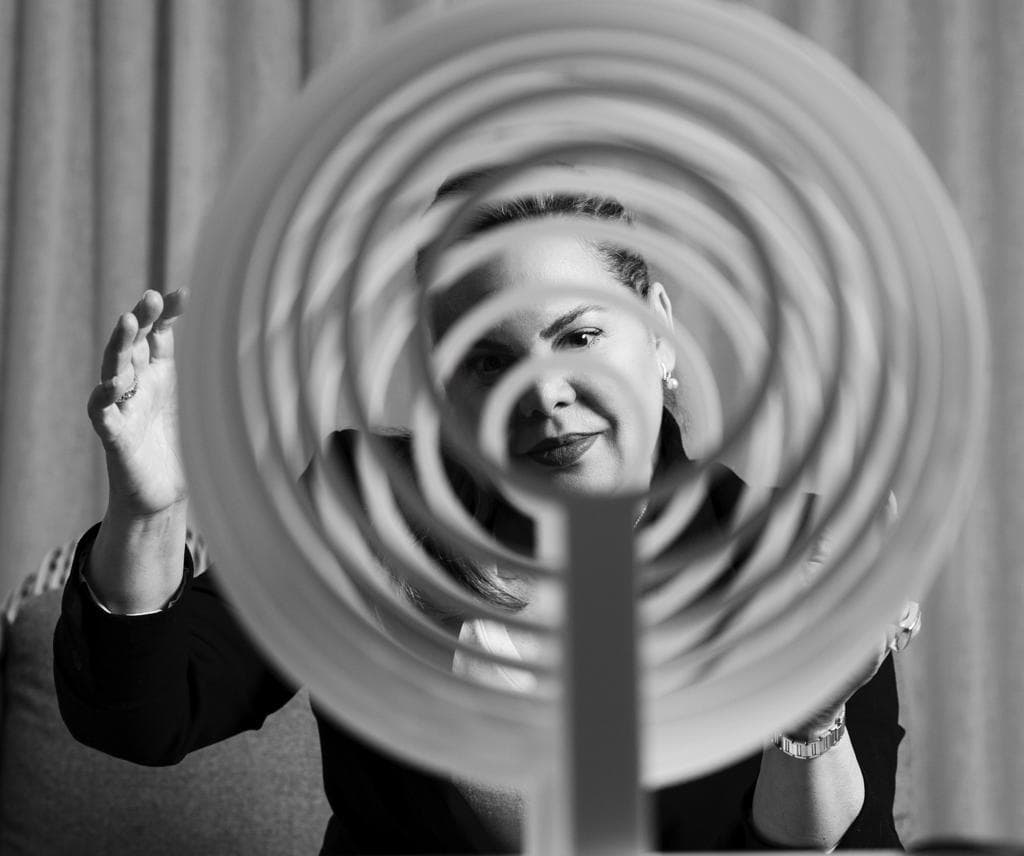
Adriana Dorta was born in Caracas, Venezuela, where her creative intuition and love for design emerged from an early age. Though initially pursuing a degree in Business Administration, she soon found her true calling in the visual arts. In 2008, she relocated to the United States to study Visual Arts, a transition that marked the beginning of her professional journey as an artist. Dorta’s work is characterized by precise geometric abstraction and a fascination with the interplay of light, form, and perception. Through meticulously constructed lines and layered color fields, she creates dynamic compositions that invite viewers into rhythmic, meditative spaces. Her practice is grounded in structure and discipline, yet her use of light and transparency evokes a sense of movement and emotion—an elegant balance between calculation and intuition. Rooted in both Venezuelan kinetic traditions and contemporary minimalism, Dorta continues to refine her visual language, exploring the infinite possibilities of geometry as a means of emotional expression. She currently lives and works in Miami, Florida, where her art has attracted an international collector base and been featured in numerous exhibitions across the U.S. and Latin America.
Artist Works
EXPLORING THE WORK BY ADRIANA DORTA
A closer look at her geometric and kinetic art
The most useful way to spend time with an Adriana Dorta artwork is to move around it. A line that looks settled from one position may seem to shift when the viewer steps sideways; a colored plane can change character as daylight crosses the room. Her compositions ask the eye to participate. They reward a second and third look because the experience is shaped by the distance between the viewer, the work, and the light around it. This is why the terms geometric art and kinetic art both matter to her practice. Geometry supplies the measured structure, while apparent movement emerges in the act of looking. The object need not contain a motor or screen for the encounter to feel dynamic.
The role of stained glass and changing daylight
Dorta has connected her interest in light to the stained glass she saw in French churches. She has described how colored glass changes as sunlight passes through it during the day, and she later studied stained glass in Miami. Those experiences help explain why her work is so attentive to illumination: a color is never only a pigment on a surface. Its appearance depends on what light reaches it, what stands beside it, and where the viewer is standing. One line can act as a boundary while the next makes the space appear open. The result invites close viewing in natural light and under interior lighting; neither condition supplies a single definitive appearance.
How lines can create the sensation of motion
In the Moving Line works, repeated marks shift between dense passages and wider intervals. Duplicated and reversed elements can appear to overlap when the spectator changes position, even though the underlying composition remains still. Dorta arranges the conditions in which a viewer perceives movement rather than simply illustrating it. A photograph can communicate palette, scale, and basic form, but it freezes one angle and one lighting condition. In person, the eye continually compares edges and spaces while the body makes tiny adjustments. Even a small step can change which lines look prominent. The pattern stays carefully composed; the experience changes with the setting.
Painting, sculpture, and works for architectural space
Dorta's own portfolio shows the breadth of her materials. It identifies acrylic painting on canvas, mixed media on aluminum, and polyurethane paint on stainless steel and aluminum among her approaches. The range is more than a catalogue of surfaces. Canvas can hold the image within a familiar rectangular field, while metal or a shaped support makes edges, reflections, and physical depth more apparent. A work attached to a wall may read as both an image and an object. A larger installation can bring the surrounding architecture into the composition. Across these formats, the question of how a viewer experiences form over time remains constant.
On her website, Dorta explains a process that can begin as a sketch, develop into a painting, and move through other media until it becomes a wall installation or a freestanding rotating sculpture. This description makes clear that a single idea need not stay within one category. The development of form is exploratory: drawing tests the relationship of shapes, painting gives the idea a new surface, and a three-dimensional version invites the viewer to move around it. Her portfolio names works such as Leaf, Circumference, Window, and Optical Vibrations, titles that point toward the recurring interests of outline, aperture, and perception without prescribing exactly what every viewer should see.
The Donut works at DelPuma Fine Art
The works currently presented by DelPuma Fine Art include Donut - Rose, Donut - Blue, and Donut - Green. Each listing identifies wood as the medium. Seen together, the three titles invite attention to what changes when a related form is encountered through a different color. Rose, blue, and green are straightforward names, but a collector's response may be less straightforward: one version may feel warmer, another more restrained, and another more closely connected to the colors already present in a room. The series gives viewers a useful opportunity to compare rather than judge a work in isolation.
For anyone considering one of these Adriana Dorta artworks, the shape and material deserve as much attention as the color. Wood gives the work a physical presence that a screen cannot fully convey. On an actual wall, the relationship between its outline, the surrounding negative space, and nearby light becomes part of the encounter. DelPuma Fine Art's individual artwork pages provide the current presentation of each piece, and the gallery's viewing tools can help collectors consider placement. A useful next step is to compare the three works at the same viewing distance, then revisit the preferred piece against the scale and light of the intended space.
Connections within geometric abstraction
Dorta's work joins a continuing conversation with artists including Yaacov Agam, Victor Vasarely, Carlos Cruz-Diez, James Turrell, and Jesús Rafael Soto. The comparison concerns artistic questions, not an assertion that her works are interchangeable with theirs. Across these different practices, color, perspective, light, and the viewer's position can change the apparent image. Dorta brings those questions into her own combinations of lines, separated elements, and spatial effects. An appreciation of those precedents can deepen a viewer's reading of her work, but it is also possible to encounter a piece on its own terms and discover the optical activity without knowing its art historical context.
A path through exhibitions and public presentations
Dorta's exhibition history places her work before audiences in Miami, New York, Dallas, Caracas, and Santo Domingo. In 2024, she presented Vibration in Color at JW Marriott Miami in collaboration with the Museum of Contemporary Art of the Americas, an event documented by Key Biscayne Magazine. Other presentations that year included Geometry in Monochrome and Dialogues in Motion. Those titles suggest how her practice supports different readings: one presentation can foreground the intensity of color, another the discipline of a restricted palette, and another the movement created through a dialogue between works and viewers. The chronology shows an artist testing her visual language in varied public settings.
Recognition for experiments in geometry
Dorta's official biography records a second-place award at the Museum of Geometric and MADI Art's 2021 Origins in Geometry biennial in Dallas. It also records that she was a finalist in the museum's 2019 edition. Those distinctions are especially relevant to her practice because they come from a setting devoted to geometric art. They do not reduce the work to a prize history; they provide independent evidence that her exploration of line, color, and space has been considered within a focused artistic field. The same biography lists a 2023 Artbox Groups catalog prize in Switzerland, adding another point in her record of international presentations.
Her work has also intersected with design and architecture. The artist's site notes a collaboration with Sectis Design whose Waves project received a Best in Show prize at ICFF South Florida in 2018. Dorta's portfolio describes Footprints, an installation in the lobby of One Thousand Museum in Miami, as honoring Zaha Hadid's legacy. These projects make sense within an artistic practice that pays close attention to how a work occupies space. They show why her art can be discussed in relation to interiors and architecture without reducing it to a decorative finishing touch.
Looking at Dorta in a home or collection
Choosing a geometric artwork often begins with color, yet Dorta's work asks for a wider set of questions. Where will a person first see it? Will the viewer approach it straight on, pass it in a hallway, or encounter it from several seats? Is the wall lit by a window, a lamp, or both? Because lines and apparent depth can change with angle, placement affects the experience in a way that a single product image cannot settle. A quiet background may emphasize the work's internal rhythm, while nearby architectural lines can set up a different conversation with it. Neither approach is automatically right; the useful choice depends on the specific piece and room.
Scale is equally important. A small work can draw someone closer and make the act of looking deliberate. A larger composition or installation can involve more of the viewer's peripheral vision and bring the wall itself into play. If an artwork uses a sculptural support, allow enough surrounding space for its silhouette and shadows to register. Collectors can also return to the work at different times of day before deciding where it belongs. That simple test respects the qualities Dorta has spent years investigating: changes in illumination, the interval between forms, and the role of the moving eye.
Why her work rewards repeated viewing
Many abstract artworks present an immediate visual impact and then reveal their subtler decisions slowly. Dorta's pieces can do both. A strong arrangement of color and shape may be apparent at first glance, while the relationship between closely spaced lines, reflective surfaces, and physical edges emerges only with attention. That layered experience helps explain the appeal of geometric and optical art in a lived space. A work can be familiar enough to anchor a room while still giving its owner something new to notice. Even when the structure remains fixed, the combination of changing daylight and a viewer's movement prevents a single, final reading.
There is also room for a personal response. Some viewers may be drawn to the measured construction, others to the color, and others to a moment when a shape seems to shift. The work makes space for those different reactions because it does not depend on a literal scene or story. Its openness is one of its strengths. The most revealing way to know a particular piece is to look carefully, step away, return, and notice which qualities remain compelling after that first impression.