Christian Albarracin
Christian Albarracín is a Colombian artist born in Bogotá in 1984, known for his innovative exploration of paper as a sculptural medium. Over the course of eight years of self-directed research, Albarracín has developed a unique technique that examines the material’s intrinsic qualities—grammage, texture, and durability—transforming this seemingly fragile substance into striking three-dimensional compositions. His works, which range from 30 centimeters to over 2 meters in height, are exposed to natural elements such as water and open air, testing their resilience and endurance over time. For Albarracín, paper is far more than a support—it is an active participant in creation. He describes it as “thin, brittle, and malleable… a noble yet complex material whose own fragility becomes its greatest strength.” His process redefines the role of paper in sculpture, positioning it as both medium and metaphor—an embodiment of transformation, memory, and impermanence. During the COVID-19 pandemic, Albarracín began developing a compelling series featuring figures seen from behind, inspired by the collective experience of disconnection and concealment brought on by mask-wearing. These anonymous forms evoke the sense of isolation, distance, and introspection that defined the period—reflecting the tension between individual identity and shared vulnerability within urban life. Through meticulous craftsmanship and conceptual depth, Christian Albarracín continues to challenge traditional notions of materiality and form. His sculptures bridge the ephemeral and the enduring, inviting viewers to reconsider the delicate balance between fragility and strength that defines both his chosen medium and the human experience itself.
Artist Works
EXPLORING THE WORK BY CHRISTIAN ALBARRACIN
Watching the ordinary city
The figures in Christian Albarracín's Subjects of the City invite a kind of attention that busy streets rarely receive. They are not portraits of public figures and they do not perform for the viewer. Their gestures suggest people absorbed in a private thought, an errand, or the simple act of moving through shared space. Albarracín has described observing passersby and making photographs without asking them to pose. That starting point helps explain the sculptures' unusual balance of specificity and openness. A posture can feel convincingly observed even when the person behind it remains unknown. The work asks us to look at the individual whom a city normally encourages us to pass without noticing.
For a viewer, the encounter is different from seeing a street photograph. Photography can preserve a fleeting instant; sculpture gives that instant physical duration. A person once glimpsed in motion becomes a presence with volume, edge, shadow, and a relationship to the space around it. The artist does not provide a complete biography for the subject. Instead, a slight turn of the shoulders or a particular stance gives the imagination room to work. This is a useful way to approach contemporary figurative sculpture: begin with what the body actually communicates, then notice the stories you are tempted to invent. The difference between observation and assumption is part of the experience.
Why the figures face away
The Backs works currently presented by DelPuma Fine Art concentrate on a point of view that portraiture often avoids. A face can seem to promise identity, expression, or direct exchange. A back withholds those clues but offers others. Clothing, weight, balance, and the direction of a figure's attention become more important. We may feel close enough to share a place with the person and yet unable to know what they see. That tension makes the sculptures especially resonant as images of urban life, where proximity does not necessarily produce familiarity. Their anonymity is not an absence of character. It is a way to preserve the distance that exists between strangers.
Albarracín has connected these turned-away figures to the experience of moving through a city in which people are preoccupied with their own paths. The work can make an ordinary encounter feel suddenly consequential. From behind, a figure also gives the viewer an implied direction of travel: one can imagine standing just outside the scene, looking with the subject rather than being looked at. The result is a subtle shift in responsibility. Instead of waiting for a face to tell us what to feel, we have to decide how much attention to give someone we cannot identify. That question remains relevant each time the sculpture is seen in a different setting.
A topography assembled from paper
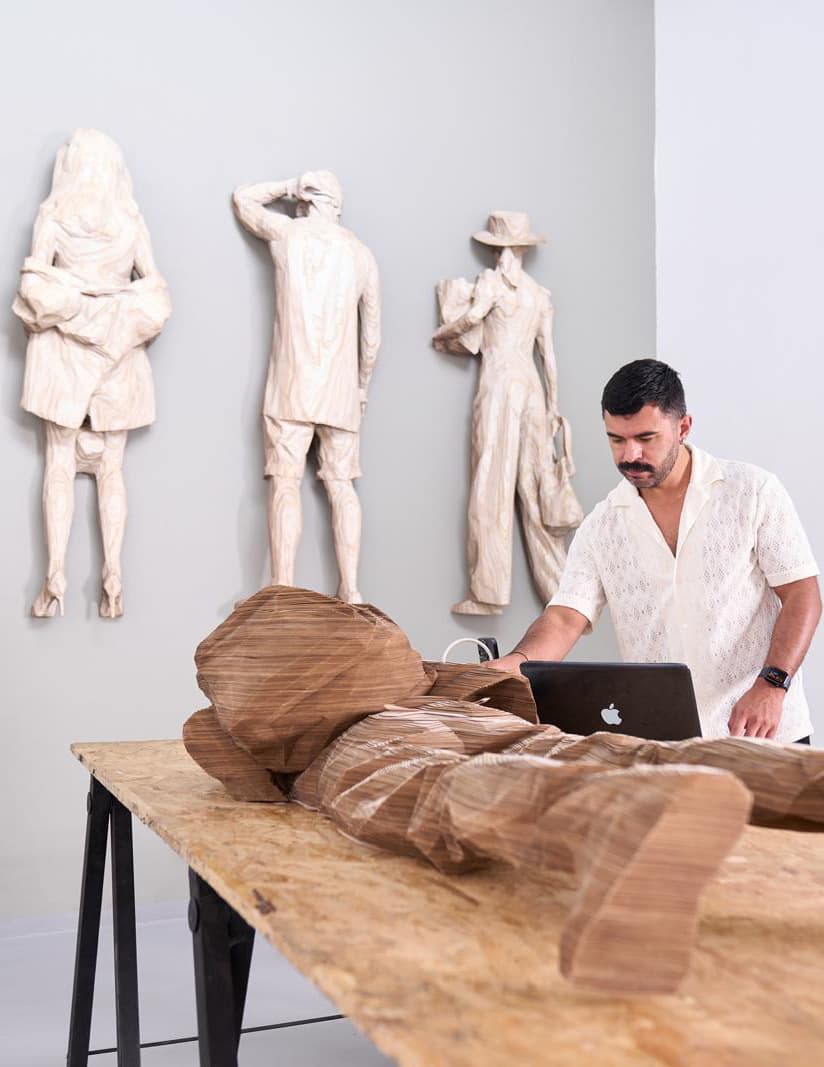
Albarracín describes analyzing the photographed body in a way that resembles reading a topographic map. Layer upon layer turns a two-dimensional outline into a three-dimensional form. That analogy is helpful because it reveals the sculpture as a record of gradual construction. In a map, closely spaced contour lines suggest a steep change; in these paper works, repeated edges help the eye understand a fold, shoulder, or transition in posture. The surface does not try to conceal every step of its making. Its rhythm lets the viewer see both the image of a person and the patient system through which that image has been built.
The works listed here are made from paper, with individual catalog entries describing thick sheets cut and hand-glued into a figure. One listing identifies recycled sugarcane paper. Those details matter because paper is commonly encountered as a thin surface carrying words or pictures, not as the mass of a sculptural body. By stacking and joining it, Albarracín changes what the material is capable of doing. The result is not an imitation of stone or bronze. Its visible strata retain a sense of paper's own history as sheet, edge, and fiber. Looking closely reveals how volume can emerge from repetition without losing the evidence of each part.
The value of a slow, manual process
In an interview with El Espectador, Albarracín contrasted his hand-built approach with faster methods such as three-dimensional printing. Speed could reproduce a shape, but it would change the meaning of the making. Cutting, aligning, and adhering layer after layer gives the work a temporal dimension that cannot be separated from the finished figure. One can think of the sculpture as accumulated decisions: where an edge should turn, how a curve should hold, when enough material has been added for the posture to read. This labor does not need to be romanticized to be appreciated. It is visible evidence that an apparently simple silhouette depends on sustained attention.
That process is particularly apt for figures drawn from brief encounters. A person might have been noticed for only a moment, yet the artwork develops through many hours of looking and making. The imbalance between the short observation and the long construction is moving. It gives a stranger a form of care that everyday traffic rarely allows. For collectors interested in process-driven contemporary art, this is one of the strongest aspects of Albarracín's practice. The material is neither merely a clever choice nor a decorative texture; it is the means through which a passing human presence becomes durable enough to be encountered again.
Paper, reuse, and material meaning
Albarracín has spoken about using paper made from sugarcane residue, connecting his process to a material that would otherwise remain a byproduct. His official site also emphasizes sustainability alongside the formal research behind the sculptures. This does not make every piece a single-issue statement about the environment. Rather, it adds another level to the transformation already visible in the object. A material associated with consumption and disposal is reorganized into a carefully made figure that asks to be kept and considered. The change in value is both physical and conceptual: what looked expendable becomes an occasion for prolonged attention.
The environmental dimension should be read with precision. A listed work may be described simply as paper, while another specifies recycled sugarcane paper. Collectors should consult the individual artwork record for its exact medium rather than assume all pieces are identical. What can be said across the practice is that Albarracín treats material choice as part of the artwork's argument. Paper brings associations of fragility, portability, memory, and record-keeping. When it is built into a human form, those associations meet the vulnerability and persistence of the body. The sculpture becomes a place where a familiar material carries an unfamiliar weight.
The role of theater, music, and observation
In the same interview, Albarracín described studying theater, playing trombone, and working in advertising before the elements of his current practice came together. These strands offer ways of looking at the sculptures without reducing them to a résumé. Theater can sharpen attention to how a body communicates before a word is spoken. Music can make repetition and rhythm feel expressive rather than mechanical. Experience with images and composition can shape how a moment is framed. The artist has described imagining one figure as a monologue and several figures together as a possible story. That idea is useful when comparing individual works in the Backs series.
A single figure can appear inward-looking, but a group introduces relationships even when the figures do not face one another. Distances become meaningful. One body may seem to wait while another moves away; a shared orientation can imply a common destination. These readings belong partly to the viewer, not only to the artist, and they can change with placement. In a collection or exhibition, the decision to show one paper sculpture alone or several together alters the scene. The works therefore reward attention to installation as well as to their individual construction. Their quietness does not mean that they have only one way of speaking.
How light completes the form
Layered paper interacts with light in a way that a flat reproduction can only suggest. An edge can cast a small shadow across the next layer; a change in viewing angle can make the same contour appear firmer or softer. The figure is not just an outline filled with material. It is a sequence of surfaces that reveal and conceal one another as the viewer moves. This is why an Albarracín sculpture may feel different at first glance and after a closer circuit. At a distance it reads as a person. Nearby, it becomes an intricate topography of cuts, joins, and intervals. Both experiences are essential.
Placement affects that reading. A background with enough visual calm helps the silhouette emerge, while side light can reveal the dimensional steps in the surface. A work should also be considered from more than one approach, especially if its subject is already turned away. The viewer's movement adds another layer to the subject of urban observation: one walks toward, around, and past the figure much as one might encounter an unfamiliar person in the street. These are interpretive suggestions, not conservation instructions. Questions about display conditions for a specific paper work should be answered from its materials and the artist's or gallery's guidance.
Exploring the current DelPuma Fine Art selection
The works currently listed on this page share the title Subjects of the City: Backs and are dated 2025. Repeated titles encourage comparison rather than the assumption that the pieces are interchangeable. One can look for differences in stance, outline, scale, and the way layered edges define the torso or clothing. The catalog also records variations in material description. A close reading of the images and individual specifications is therefore more informative than relying on the series name alone. The strongest connection with a piece may come from a small detail that first seems incidental: the angle of a shoulder, the distribution of weight, or the shape of the space around the figure.
As contemporary Colombian sculpture, Albarracín's practice joins questions of craft, urban identity, and the physical possibilities of paper without forcing them into a single message. The city supplies fleeting subjects; the making supplies duration; the viewer supplies an act of recognition. Those three times meet in each finished work. A person who might have disappeared into the crowd instead remains available for another encounter. This is what makes the Backs series more than an exercise in unusual material. It offers a disciplined way to reconsider who becomes visible and what it means to grant an ordinary life our sustained attention.
Research sources: Christian Albarracín's official site and his interview with El Espectador. Artwork details are from the current DelPuma Fine Art listings.