Canal Cheong Jagerroos
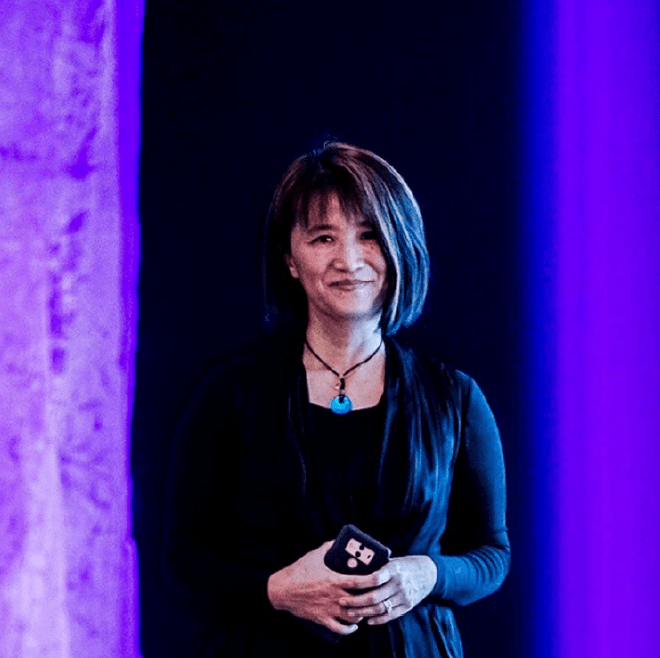
Canal Cheong Jagerroos is an established Chinese contemporary visual artist whose practice has been shaped by a lifetime immersed in art and cultural exchange. Born into an artistic family in Macau, she now lives and works between Helsinki, Shanghai, Nice, Tokyo, and Berlin, maintaining a truly global creative presence. Across more than three decades, Cheong Jagerroos has lived and worked throughout Asia, Europe, and Africa — including Hong Kong, Shanghai, France, Switzerland, Italy, Senegal, and Finland. These environments, each with their distinct histories and visual languages, have profoundly influenced her work. Moving between East and West, she has come to understand cultural intersections as both challenging and enriching, ultimately forming a wellspring of inspiration for her artistic voice. Drawing from the visual traditions of both hemispheres, Cheong Jagerroos creates her own hybrid language. Her works blend calligraphy, symbolic marks, layered surfaces, and abstracted forms, forming compositions that feel both ancient and contemporary. The result is a visual dialogue that bridges continents, philosophies, and time. In 2015, she co-founded the Blue and Red Project, a collaborative initiative that was exhibited extensively across art museums in China and Finland from 2018 to 2020. In 2017, she launched her ongoing project Floating Island, further expanding her exploration of cultural fluidity, identity, and the spaces between worlds. Cheong Jagerroos’s work continues to evolve as she moves through cities and cultures, reflecting a life lived in motion and an artistic practice grounded in openness, curiosity, and cross-cultural understanding.
Artist Works
EXPLORING THE WORK BY CANAL CHEONG JAGERROOS
A language assembled from fragments
Canal Cheong Jagerroos builds images in which a mark can seem both ancient and newly made. Her mixed-media practice brings ink, paint, paper, and other materials into a conversation that does not settle into one cultural or formal category. The biography above describes the many places that have shaped her life. The work beneath it asks a more immediate question: how can an artist make the experience of moving between places visible? Rather than illustrating a journey, Cheong Jagerroos lets fragments meet on the surface. A line may suggest writing without becoming a message that every viewer can read. A field of color may support that line, interrupt it, or carry it into another visual register.
Her documented process begins with large ink drawings on rice paper that she tears and recomposes with paint and varied materials. The torn piece retains traces of a previous whole, yet gains a new role in the final work. This is not merely an attractive texture. It is a way of making transformation tangible. A fragment can hold memory while participating in a composition that did not exist when the first drawing was made. Looking closely at overlapping edges, exposed paper, and changes of opacity helps a viewer understand the work as an accumulation of decisions rather than a single spontaneous gesture.
Calligraphy beyond literal reading
Calligraphic movement is central to Cheong Jagerroos's visual language, but the presence of a writing-like mark does not mean that a painting is a text waiting to be translated. A stroke can carry pressure, rhythm, hesitation, and speed before it carries a word. In this sense, the work invites viewers from different linguistic backgrounds without asking them to erase the traditions from which the marks emerge. The viewer can recognize the dignity of the mark's history and still respond to its shape, scale, and relation to the surrounding color.
A useful way to begin is to follow one line with the eye. Does it move freely across the field, or meet a torn edge? Is it repeated nearby in another direction? Does the line feel stable because of its placement, or temporary because another layer passes over it? Questions like these avoid treating East-West exchange as a simple mixture of decorative motifs. The work is more complicated and more personal. It gives form to the way signs can change meaning when they move across material, language, and place, while allowing an individual viewer to experience that movement directly.
Floating Island as an evolving idea
Floating Island is an ongoing project that has appeared through paintings and textile-based installations. Its title proposes a place that is neither fixed nor entirely free: an island has a distinct form, yet here it moves. That paradox is a productive way to think about belonging. The project has been presented in museums in Finland and China, and its different iterations suggest that Cheong Jagerroos does not regard a cultural identity as a finished destination. Instead, place can be revisited and reconstructed as one's relationship to it changes.
The installation format also matters. A viewer walking among large paintings or textile elements meets the work with the body, not only the eye. Distance alters the reading of a mark; a field of color can feel expansive from across a room and intricate from a step away. The individual mixed-media works available here are not miniature versions of an installation, but they share its interest in layers and movement. Looking at them alongside the project's broader history can clarify how a single composition participates in a continuing exploration without needing to illustrate a specific episode from it.
What the current works invite us to compare
The DelPuma Fine Art selection currently includes Dialogue, Visible, Rose, Vase and Flowers, and Wind's Whisper II. All five are listed as mixed media, with dates from 2023 to 2025. Their titles offer different points of entry: conversation, perception, botanical form, and the movement of air. A title may direct attention, but it should not be mistaken for a complete description of the image. Instead, let it become a question. What sort of dialogue can take place between an ink fragment and a painted field? What has been made visible through layering, and what remains partly concealed?
Comparing several works is particularly valuable with an artist whose materials can change from piece to piece. One may feel dense and compact; another may give the eye more open space. A floral title may lead us to expect representation, only for the work to emphasize the rhythm or atmosphere associated with a flower. A wind title may suggest movement even if the composition contains passages of remarkable stillness. These contrasts prevent a single label such as abstract or calligraphic from flattening the practice. Each artwork asks for its own pace of looking.
The material intelligence of mixed media
The term mixed media is useful, but broad. It tells a collector that more than one material or method contributes to a work; it does not specify every ingredient or explain how the surface was constructed. Cheong Jagerroos's account of torn rice-paper drawings offers one documented route into that process. It encourages close attention to joins, textures, and partial disclosures. A painted layer can conceal part of an earlier mark while allowing another part to remain visible. The history of the image is therefore present without being fully recoverable.
This material logic can carry an emotional charge. Something once whole has been separated, but the separation is not presented only as loss. Recomposition creates new relations. Colors and marks that began apart can share a field and produce an unexpected balance. The viewer need not translate that balance into a fixed story about migration or identity, though the artist's cross-cultural life provides meaningful context. The physical process itself is compelling: it lets the eye move from a torn edge to a new line of connection and back again. That movement is one reason these works reward time beyond an initial glance.
Color as an active participant
A layered abstract painting can make color behave in several ways at once. It may be a background, an interruption, or a bridge between distinct marks. In Cheong Jagerroos's practice, color often has to share space with the directional energy of ink and the texture of assembled material. Ask where the eye rests first and what takes it onward. A strong chromatic area might gather the fragments into one composition; a quieter passage might give the calligraphic movement more room to breathe. These relationships are formal, but they influence the work's emotional temperature.
Color can also complicate an expectation raised by a title. Rose need not rely on a literal rose to evoke growth, delicacy, or a vivid center. Wind's Whisper II might use color to suggest atmosphere rather than an identifiable landscape. Such readings should remain open to correction by the actual image. The point is to look for how chromatic choices operate within each work, not to assign a symbolic meaning to every hue. Contemporary abstraction becomes more rewarding when we notice relationships—warm against cool, opaque against translucent, expansive against compressed—before deciding what the painting is 'about.'
Between intimacy and an international practice
Cheong Jagerroos's career reaches across countries and exhibition formats, from individual paintings to environments made for public encounter. That breadth can be impressive, but the close experience of a single work remains essential. At home, the viewer can return to the same composition in different light and notice a new alignment of marks or a previously quiet area. The work's international context enriches the viewing; it does not replace it. A painting succeeds when its particular arrangement of materials continues to hold attention after the biographical facts are known.
For a collector, this makes the relationship between image and space especially important. Look at the listed dimensions and imagine how the work will be approached from the doorway and from nearby. Does the composition establish a coherent presence at a distance while preserving details for close inspection? Would its color converse with the room or stand apart from it? There is no universally right answer. Cheong Jagerroos's art is built from dynamic relationships, and choosing one work involves finding the particular balance of movement, texture, and stillness that remains meaningful in your own setting.
Looking again at Canal Cheong Jagerroos
The artist's mixed-media works bring a long inquiry into form and cultural exchange into the scale of individual objects. Their layered surfaces do not ask us to pick a single identity for a mark. A fragment can be part of a drawing and part of a new construction; a gesture can recall calligraphy and operate as abstraction; a title can point toward the natural world without dictating a literal scene. This openness is not vagueness. It is the product of precise relationships between materials, intervals, and color.
Start with one of the current works, then return to another and notice what changes. Dialogue might prompt attention to an exchange between elements, while Visible asks what the surface lets us see. Vase and Flowers offers a familiar subject that may be transformed through mixed media. The aim is not to force all five paintings into a single explanation. It is to let each artwork show how Cheong Jagerroos turns movement across forms and traditions into an encounter that can be experienced in the present. That is where the work's complexity becomes inviting rather than distant.
Research: artist biography and CV and Floating Island project documentation. Artwork titles, dates, and media are from current DelPuma Fine Art listings.