Carlos Villabon
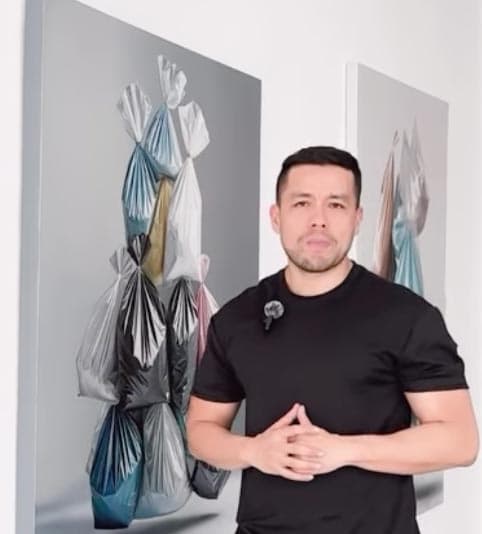
Carlos Villabón was born in Espinal, Tolima, Colombia, in 1983. From a young age, he demonstrated a sharp eye for the world around him—capturing the austere beauty, contrasts, and quiet magic of his environment through paint. What began as simple observation soon evolved into an artistic practice that bridges technique and concept, emotion and intellect. Villabón’s journey traces a thoughtful evolution through impressionism, surrealism, and conceptual exploration. His work draws from art history while remaining distinctly contemporary, transforming classical motifs into new visual languages that both surprise and invite reflection. Known for his large-format paintings, he uses scale as a vehicle for immersion—inviting viewers to step into the tension between form, meaning, and emotion. A conceptual artist at heart, Villabón’s mastery of painting remains central to his expression. His canvases explore the delicate relationship between light and darkness, examining how the materials and spaces between these extremes influence imagination, perception, and memory. Each work becomes a meditation on the unseen—how the intangible forces of light, shadow, and substance shape our emotional landscapes. Today, Carlos Villabón continues to expand his visual dialogue, crafting works that transcend the boundaries between realism and thought, inviting contemplation through both beauty and depth.
Artist Works
EXPLORING THE WORK BY CARLOS VILLABÓN
When a familiar thing becomes uncertain
Carlos Villabón often begins with a recognizable subject and then unsettles the confidence with which we recognize it. A bag, a toy-like shape, or a body of light can seem immediately legible before the composition asks a second question. Are we looking at the thing itself, a representation of it, or an image of the assumptions we bring to it? The biography above traces his movement through different artistic languages. His recent paintings and sculptural works make the conceptual side of that practice concrete. They allow an ordinary material to become a problem of perception without surrendering the visual pleasure of painting and form.
The title It's Not a Rabbit, It's Just a Plastic Bag makes this tension explicit. It names an animal only to deny that identification and replace it with an everyday object. The title is not a riddle with a single clever answer. It draws attention to how quickly the eye organizes ambiguous shapes into something familiar. The artist can then work in the space between what the viewer first sees and what the object materially is. This gives his contemporary Colombian art a distinctive kind of humor and a more serious question about certainty.
The plastic bag as an image of perception
On his own website, Villabón describes a rural Colombian custom in which a water-filled plastic bag is used to discourage flies and other insects. The commonplace device stayed with him and later entered his art in an ambiguous form. This origin matters because it keeps the work connected to observed life, not to an abstract idea imposed from outside. The bag is practical, humble, and visually odd. It holds water, catches light, and changes shape with its contents and surroundings. Such qualities make it unusually fertile for a painter interested in the unstable boundary between material fact and imagined form.
Yet knowing the anecdote should not end the encounter. An artwork can outgrow the circumstance that first prompted it. A viewer unfamiliar with the custom may see a strange, glossy body or a creature that almost exists. Someone who knows the source may become more alert to how perception produces those associations. Both responses are valuable. Villabón uses the ordinary bag to show that meaning does not reside only in an object or only in the viewer. It arises in the exchange between the two, shaped by light, context, memory, and expectation.
Painting and sculpture in conversation
The current DelPuma Fine Art selection includes oil-on-canvas works such as Balloon, Closeup, Dance, and It's Not a Rabbit, It's Just a Plastic Bag. It also includes fiberglass works titled It's Not a Teddy Bear, It's Just a Plastic Bag in black, fuchsia, and white, along with Proliferation. This range matters. When a bag-like image is painted, the eye reads an illusion on a flat support. When a related form becomes a physical object, the viewer can move around it and watch the room's light change its appearance. The conceptual question remains, but the body encounters it differently.
It would be too simple to call the sculptural work a three-dimensional illustration of the paintings. Each medium has its own demands. Oil can direct attention through a precise arrangement of highlights and shadows, while fiberglass occupies actual space and casts actual shadows. Color can shift the character of a form without altering its outline, which makes the three teddy-bear variants especially useful for comparison. How does the same named idea behave in black, fuchsia, or white? Which version feels playful, uncanny, or severe? The answer may change as the surrounding light changes.
The role of illusion
Villabón's painting is technically accomplished, but technical control serves an inquiry rather than replacing it. The more convincingly a surface is rendered, the more persuasive its apparent identity can be. A glint may make plastic seem wet; a contour may turn a folded bag into the suggestion of an ear. This is where the work can become briefly disorienting. The viewer knows that the image is painted and may know what the subject is, yet still experiences the pull of another recognition. The tension makes perception itself visible.
Art history is full of images that test the boundary between what is painted and what appears to be present. Villabón engages that long conversation without simply repeating an old trick. The setting, scale, and choice of an inexpensive contemporary material change the stakes. A plastic bag is associated with consumption and disposal; it is not a traditional emblem of permanence. To render it with great care is to grant the object a surprising gravity. The artist does not dictate whether the viewer should find it beautiful, absurd, troubling, or all three. The painting keeps those responses in play.
Light, darkness, and what lies between
The artist's account of his practice emphasizes light and darkness and the materials that mediate between them. That idea is especially useful when looking beyond the name of a pictured object. A transparent or reflective material becomes visible because it alters light. Its outline may be less important than the distortions, highlights, or shadows it creates. Villabón's work invites attention to these intermediate effects. The subject is not merely placed in a lit scene; the material helps construct the scene's visibility.
This attention to mediation can produce emotional uncertainty. Brightness may feel revealing in one passage and deceptive in another. A dark area may give a form depth or make it harder to place. In a large painting, these relationships can occupy much of the viewer's field of vision and slow down quick identification. Look at how the eye moves between illuminated and obscured areas. Does the work confirm the first impression or begin to undo it? The answer can be more interesting than deciding whether a painted shape resembles a rabbit, a bag, or something else entirely.
A closer look at the 2024 paintings
Balloon, Closeup, Dance, and It's Not a Rabbit, It's Just a Plastic Bag are all listed here as 2024 oil paintings. Their titles suggest several ways of seeing: an object that floats, a view brought near, movement, and a deliberate correction of visual identity. Consider them as separate compositions before treating them as a series. A close view can make ordinary texture strange. A movement-oriented title can make a still image feel active. The paintings' shared medium allows a viewer to compare how Villabón uses oil for distinct effects rather than assuming one technique or emotional register governs them all.
The artwork pages provide dimensions and individual descriptions where available. Those details matter because an image on a screen can make works of different sizes feel deceptively similar. A large canvas can bring an ambiguous form into the viewer's physical space; a smaller work may reward concentrated attention. If possible, consider the painting at its listed scale and note the relationship between recognizable form and surrounding field. The strongest response may come from the work that leaves the greatest room for your own act of looking, not the one whose subject is easiest to name.
The contemporary life of discarded materials
A plastic bag is a contemporary object with a complicated life. It can be useful for minutes and persist far longer than its intended use. Villabón's work does not require the viewer to read every bag image as a single environmental message, but the material's everyday status is hard to separate from its appearance. Its cheapness contrasts with the time-intensive labor of oil painting and the durable presence of a sculptural form. That contrast can create a moment of productive discomfort: why has something so easily overlooked been given such attention?
One answer lies in the artist's refusal to rank subjects by conventional prestige. A work can begin with an object at hand and still open questions about waste, desire, ingenuity, or illusion. The paintings do not need to declare those themes in slogans. Their ambiguity lets viewers discover connections at their own pace. This approach is particularly suited to a world crowded with images, where recognition is quick and sustained attention is scarce. Villabón asks the viewer to return to the material facts of a thing and notice how imagination has already changed them.
Encountering Carlos Villabón at DelPuma Fine Art
The present selection offers a compact view of painting and fiberglass sculpture from 2024 and 2025. Begin with the work that catches your attention, then compare it with one in another medium. Does a painted illusion feel more stable than a sculptural object, or less so? How does the chosen color affect the character of a repeated form? These comparisons are more revealing than a broad style label. They show how Villabón can use a consistent conceptual question to produce materially different experiences.
For collectors, the appeal of these works can lie in their double life. They are visually striking objects for a room, but they continue to ask how a viewer decides what is real, valuable, or worth looking at. Read the listed medium and dimensions, examine available images, and consider how the object will be approached in its intended space. A satisfying choice is one that keeps both sides active: the immediate encounter with shape and color, and the slower realization that the work has made an ordinary thing unexpectedly difficult to dismiss.
Research: Carlos Villabón's artist biography and Segunda piel project notes. Artwork titles, dates, and media are from current DelPuma Fine Art listings.