Lisa Lloyd
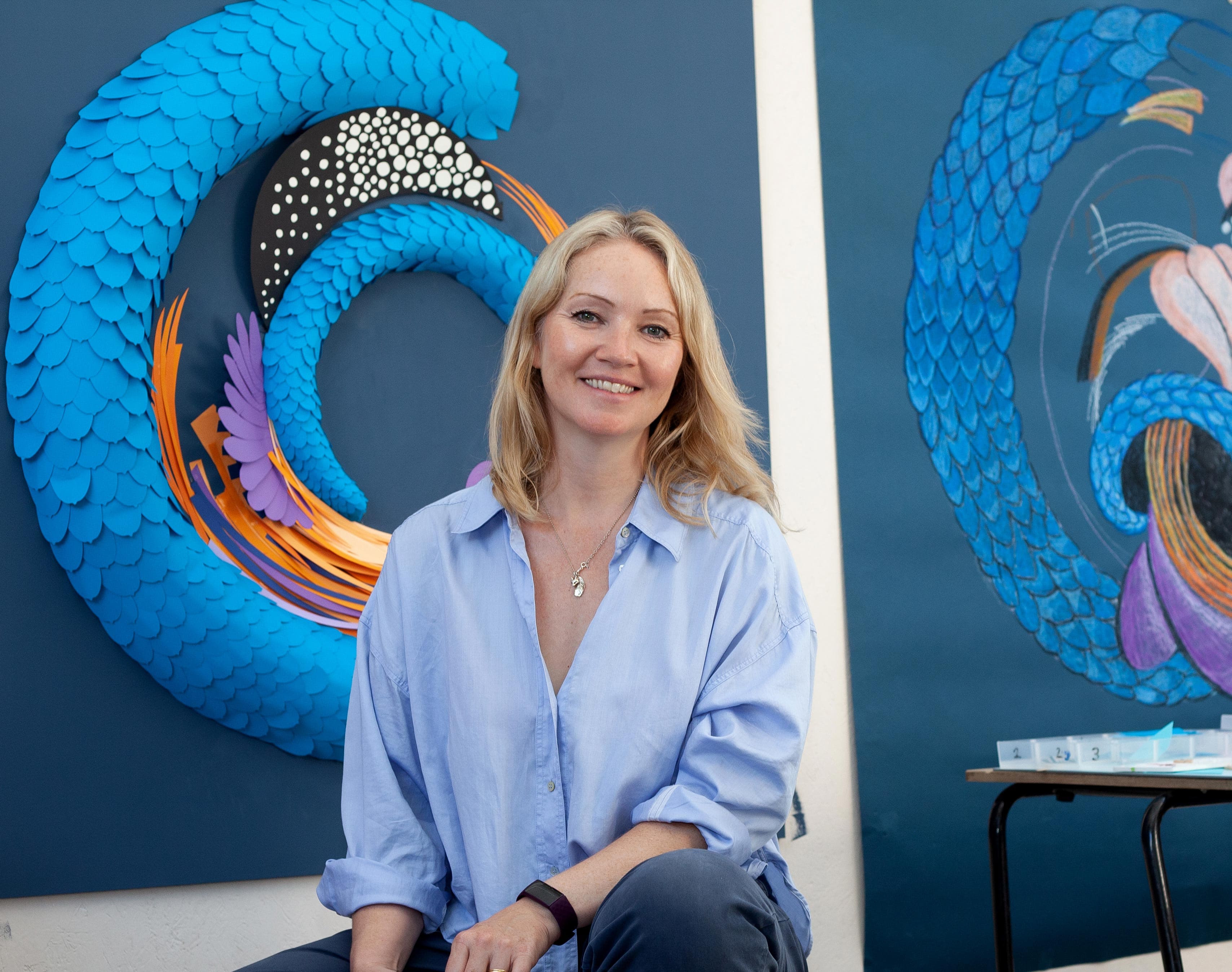
Lisa is a British artist whose career spans over two decades across the worlds of design, film, and fine art. She began her creative journey in London’s commercial industry as a graphic designer and animator, producing television commercials and visual content for the music industry. Her evolution from designer to live-action director allowed her to bring narrative, rhythm, and emotion to moving images—a foundation that continues to influence her visual storytelling today. A decade ago, Lisa redirected her creative focus toward paper art, developing a distinctive practice that combines craftsmanship, precision, and expressive form. Her intricate hand-cut and sculpted paper works have been commissioned internationally for editorial projects, large-scale installations, and visual merchandising. Each piece reflects a deep engagement with both the fragility and strength of her chosen medium. Now working as a full-time artist, Lisa draws profound inspiration from nature—its quiet details, its immense power, and the tension that exists between them. Her process is deeply meditative and physical, an immersive act of transformation in which paper becomes both subject and metaphor. Through movement, color, and texture, she channels emotion into form, exploring the delicate balance between hope and fear, creation and release. Lisa is currently developing a new large-scale series inspired by metamorphosis, a theme that mirrors her own creative evolution—a continual process of renewal, resilience, and artistic rebirth.
Artist Works
EXPLORING THE WORK BY LISA LLOYD
Paper engineering as an expressive art
Lisa Lloyd's sculptures demonstrate that the intelligence of a form can be hidden within its structure. Her official site describes three-dimensional works made through paper-engineering techniques, sometimes using only paper and glue. A finished object may appear to float, curl, or grow naturally, but it depends on careful decisions about support, balance, and how one cut element meets another. That construction is not merely a technical feat. It allows Lloyd to give physical shape to ideas that might otherwise remain abstract: change, vulnerability, protection, and the movements of living systems.
The short biography above outlines her transition from commercial image-making into a full-time paper practice. The artwork invites a closer question: what can paper do that another material cannot? It can hold a crisp edge while appearing almost weightless; it can be folded or cut into repeated units that create a larger rhythm. Its apparent fragility can intensify the viewer's awareness of the effort required to sustain a form. In Lloyd's hands, paper becomes an active participant in the meaning of the work, not a substitute for a supposedly stronger sculptural material.
Acropora and the ecology of attention
The DelPuma Fine Art listing for Acropora connects the sculpture to bleached coral and the marine life that depends on a balanced habitat. Lloyd has explained on her own site that she encountered images of bleached coral while researching fish. She was struck by a structure whose intricate beauty becomes visible at a moment of ecological danger. That contradiction gives the work its emotional force. The pale form can appear exquisite, but its appearance is not simply celebratory. It asks the viewer to consider what has been lost, what remains, and what other life depends on its condition.
The sculpture is made from paper and card, including its internal construction and outer textures. This material choice is unusually apt for the subject. Paper can convey intricacy without pretending to be coral; it can preserve the visual rhythm of branching and shelter while making its own vulnerability evident. The artist's account records approximately 150 hours of making. That duration is not a measure of ecological value, but it signals a prolonged act of attention. A form that might be passed quickly in a photograph is rebuilt so that its dependencies and fragile balance can be encountered more slowly.
The importance of the unseen interior
A paper sculpture is often judged by the complexity of its visible surface, yet its hidden structure may be just as revealing. Acropora's catalog description specifies that even its internal form is handcrafted from paper and card. Knowing this changes the way a viewer understands the object. Its outer delicacy does not rest on a concealed industrial core. The support belongs to the same material world as the visible branches and textures. Structure and appearance are therefore related, not opposed. The piece makes its own means of standing part of the artistic idea.
That relationship between inside and outside recurs in Lloyd's broader interest in transformation. Her writings about the chrysalis describe an exterior that protects a period of unseen change. Acropora is a different work with a different subject, but both encourage attention to what cannot be read from a single glance. A surface may be a sign of an interior process, and an apparently delicate shell may carry complex work within it. For viewers, this means that a sculpture can continue to unfold after its silhouette is recognized. The question becomes not just what it resembles, but how it holds together and what that hidden organization asks us to value.
Nature at different scales
Lloyd writes about finding circular forms and symmetry in settings ranging from the patterns of insects to the sweep of a bird's wing and the movement of fish. Her attraction to these structures is not a requirement to reproduce nature literally. A microscopic detail can be enlarged until it feels architectural; a large natural rhythm can be distilled into a compact form. Moving between scales is one of the powers of sculpture. It can make a viewer feel close to something usually overlooked or step back from a familiar subject and see it as part of a wider system.
This perspective helps when looking at Acropora beside Fate, the two works currently listed here. They differ in stated medium—paper for Acropora and silver foil card stock for Fate—and their titles lead toward different readings. Yet both can be approached through the interaction of material, movement, and light. Does a repeated unit produce a natural rhythm? Does a reflective surface pull attention outward while a matte one draws it inward? These questions do not impose one meaning on either work. They keep the encounter anchored in the visual and physical choices the artist has made.
Circles, repetition, and making as a rhythm
On her official site, Lloyd describes returning to circular, twisting, and sweeping forms even when she has not consciously planned to do so. She also connects repetition in her process to a sense of calm. This offers a useful distinction between the experience of making and the emotional character of the finished work. The artist may find steadiness in repeated acts while the resulting sculpture feels turbulent, delicate, or even dark to a viewer. Form does not simply translate one mood into another. It can hold contrast between the rhythm of construction and the energy of what is seen.
A viewer can look for this rhythm in the repeated elements of a paper sculpture: cuts, folds, edges, and units that collectively create motion. Repetition makes difference easier to notice. One slight turn can interrupt an otherwise regular sequence and direct the eye into a new path. In this way, a carefully made object can feel alive without pretending to move mechanically. It asks the viewer's own movement to complete it. As the angle changes, overlapping forms separate or merge. The experience is slow and bodily, even when the material itself is light.
Light, display, and the limits of a photograph
Paper's appearance changes with finish and illumination. Lloyd notes that her smaller studio pieces may use matte, glossy, or heavily textured papers, sometimes worked with other media. A reflective card stock such as the medium listed for Fate can catch light differently from the paper structure of Acropora. Photographs provide a useful first reading of silhouette and color, but they compress shadows and make it harder to judge depth. A paper sculpture asks for attention to both the bright edge and the space behind it. Its negative spaces can be as important as its solid parts.
The artist's site describes display possibilities for some works, including cases, box frames, or glass domes. Those examples show how presentation can shape an encounter, but they should not be taken as specifications for every piece. The individual listing and the artist's guidance should determine how a particular sculpture is mounted and cared for. The broader aesthetic principle is clear: enough room and thoughtful light let the work's construction become visible. A viewer should be able to step back to grasp the overall form and approach to find the finer decisions that give it life.
From paper to future materials
Lloyd has written about extending her practice into metal and processes such as electroforming. The interest does not imply that paper was a temporary stage. It suggests an artist asking how a delicate form might change when translated into a more enduring material. A shape developed in paper can carry the memory of cutting and assembly even when its later form has another weight. This makes her practice a continuing investigation of what persists through material change. The subject is not just the object produced; it is the relationship between a formal idea and the substance that gives it presence.
For the works currently shown at DelPuma Fine Art, the stated media remain paper and silver foil card stock. It would be misleading to describe those specific pieces as metal sculptures because her broader research is moving in that direction. Instead, consider them as points within an evolving vocabulary. They reveal how she uses fragile or light materials to create forms with a strong spatial and emotional presence. The possibility of future translation into another medium makes their paper construction no less complete. It may make their particular material intelligence easier to appreciate.
Living with Lloyd's work
Acropora and Fate offer two different entrances into Lisa Lloyd's contemporary paper art. One has a stated connection to coral bleaching and ecological interdependence; the other opens with a title that is more elusive. Both ask the viewer to notice how a light material can organize space and feeling. The current artwork pages provide the images, dimensions, and availability needed for a practical decision. Before that decision, it is worth lingering on the way an edge, fold, or reflective passage changes the whole. The strongest response often grows from such details rather than from a general admiration of craftsmanship.
Lloyd's practice is compelling because its delicacy is never merely decorative. It is built, measured, and tested against forces that paper must accommodate. The sculptures can evoke living systems, hidden transitions, and the beauty of forms that may also be under threat. The short biography above explains how she came to this material; the works show what it allows her to say. A viewer may arrive for the intricacy and remain for the thought it makes possible: how much is held within a fragile structure, and how might looking more carefully change our sense of what deserves protection?
Research sources: Lisa Lloyd's official site, her Acropora process notes, and her sculpture overview. Artwork details are from the current DelPuma Fine Art listings.