
Marissa Oosterlee
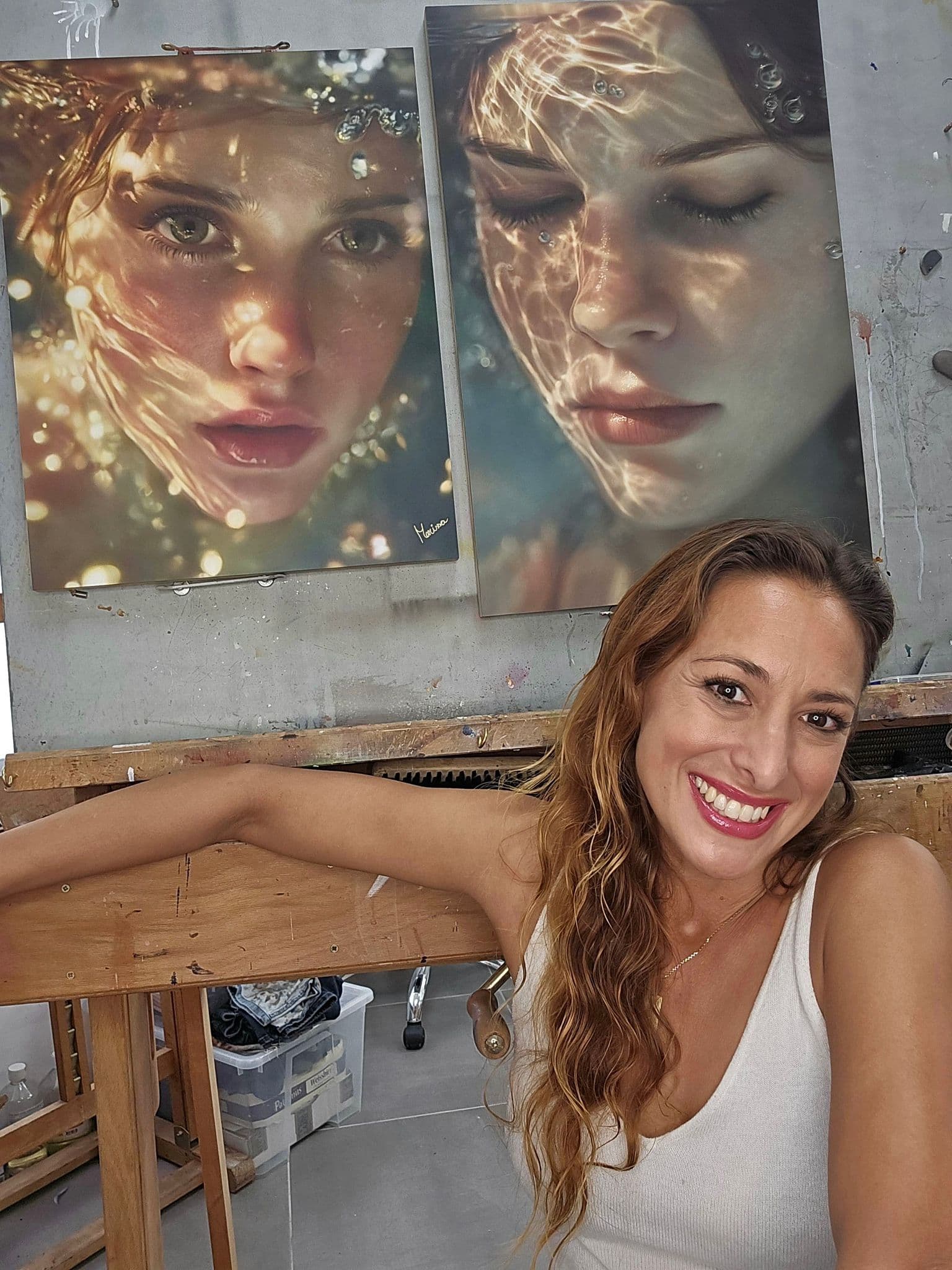
Marissa Oosterlee is a Dutch artist known for her hyperrealistic oil and airbrush portraits that invite quiet contemplation. Her work is defined by grace, stillness, and an almost meditative presence. Each portrait feels like a suspended moment—intimate, sensual, and serene—where the viewer encounters the subject in a deeply personal way. Though technically precise, her paintings move beyond realism, creating an emotional space where softness, purity, and introspection take center stage. In her celebrated series Washing Away My Sorrow, Oosterlee depicts ethereal women floating in luminous water, their faces rendered with near-photographic clarity while their surroundings dissolve into subtle abstraction. Water plays a central role in her practice—not only as subject matter, but as metaphor. Reflections, distortions, and shifting light introduce a dreamlike quality that blurs the line between realism and abstraction, grounding her work in both precision and poetry. Fascinated by the sea and its constantly changing surface, she captures the way reality transforms beneath water—fluid, layered, and in motion. Oosterlee’s work has received international recognition, including multiple awards for portraiture and hyperrealism, and has been exhibited widely across Europe and the United States. Her paintings have been shown at galleries and institutions in the Netherlands, Italy, France, Spain, and the U.S., and featured in leading art publications worldwide. Collected internationally, her work resonates with viewers for its technical mastery, emotional depth, and the quiet power with which it speaks—offering moments of calm, beauty, and reflection in an otherwise fast-moving world.
Artist Works
EXPLORING THE WORK BY MARISSA OOSTERLEE
Stillness that is carefully constructed
Marissa Oosterlee's paintings can feel quiet at first encounter, but their quietness is the result of active choices. A face may be rendered with remarkable precision while the surrounding field becomes less certain. The viewer's eye finds a place to settle, then begins to notice reflections, softened boundaries, and changes in light. This movement between clarity and dissolution is central to her work. It prevents hyperrealism from becoming a demonstration of skill alone. The accurate image gives emotional ambiguity somewhere to live. We can recognize a figure without being told exactly what that figure thinks or remembers.
The biography above introduces the water imagery and the contemplative character of Oosterlee's portraits. Below the artwork, it is useful to look more closely at how those effects are made. Realistic detail directs attention toward a human presence; abstraction around it gives that presence room. The painting becomes a negotiation between what can be seen clearly and what remains fluid. This is why a technically accomplished surface can still feel open rather than closed. The viewer can admire its control and return for the uncertainties that control has made visible.
Water as a changing lens
In the Washing Away My Sorrows series, water does more than surround the subject. It acts as a lens that alters what can be known. Refraction can soften a contour, shift a color, or place part of a face at a slight visual distance. Oosterlee's own description of the series connects water with clarity, tranquility, and the need to clear one's thoughts. Those associations are not a complete explanation of any single painting. They offer a starting point for asking why a body seen through water can feel both present and temporarily unreachable.
The sea is never completely still, even when a painted moment appears suspended. This underlying movement lends the work a tension that a straightforward portrait might not have. A face can be sharply observed while its setting refuses to remain fixed. One might read the water as cleansing, concealment, memory, or transition, but the painting does not require the viewer to choose a single metaphor. It lets the physical behavior of light and water carry part of the emotional complexity. The experience is strongest when we attend to those formal decisions before settling on a story for the figure.
Looking at Washing Away My Sorrows IV
The current DelPuma Fine Art listing identifies Washing Away My Sorrows IV as a 2020 oil painting on gesso board. Its place within a numbered series encourages viewers to consider it both individually and as part of an ongoing investigation. The number does not make it a mere stage in a sequence; the composition has to work on its own. Look at how the subject's features hold the viewer's attention and how the surrounding passages affect that first focus. Does the image feel as though it is emerging from water, being held by it, or moving away through it?
The official series description frames the paintings in relation to past, present, and future. That temporal idea can help explain why the image feels like a suspended instant rather than a conventional posed portrait. A present face may carry the pressure of what has happened and the possibility of what may change. The painting does not narrate those times explicitly. It makes them available through an atmosphere of pause. A collector encountering the work may first respond to its serenity and later notice how much uncertainty remains within that apparent calm. That second response gives the painting its staying power.
The difference between realism and presence
A realistically painted face can sometimes be mistaken for a photograph, yet the difference is not only technical. Painting involves a series of judgments about which details to sharpen, which to soften, and how the surface should direct attention. Oosterlee's use of oil and airbrush in her broader practice allows fine transitions, but the purpose of those transitions is not simply to mimic a camera. They can establish a feeling of proximity or distance. The viewer may feel close to the subject's skin and far from the subject's thoughts at the same time.
This separation between visual access and emotional certainty is important to the work. A portrait does not become intimate merely because its features are clear. Intimacy is made through gaze, light, scale, and the space allowed around a figure. Oosterlee's paintings often leave enough openness for a viewer's own memories to enter. The person depicted is not reduced to a single mood or message. Instead, the work invites a slower encounter with someone whose presence is compelling precisely because it remains partly unknowable. Hyperrealism becomes a doorway to contemplation rather than an end in itself.
From luminous water to Metallic Reefs
Metallic Reefs, another 2020 work currently listed here, is described as acrylic and oil on board. Its title suggests a different way of approaching the marine world from the face-centered Washing Away My Sorrows series. A reef is a habitat, a structure, and a place of layered life. The word metallic introduces an unexpected surface quality. Without assuming a literal depiction from the title alone, a viewer can look for how the painting sets natural forms against a sense of sheen or manufactured light. This contrast may shift attention from a single human subject to an environment made of interdependent parts.
The stated combination of acrylic and oil is also worth noticing. Different media can be used to establish distinct levels of opacity, edge, or finish, though the specific technique of this work should be judged from the object rather than inferred from a label. Compare Metallic Reefs with the oil-on-gesso-board portrait for how each organizes detail. Does one feel more expansive or more concentrated? Do highlights direct the eye through a field differently from reflections around a face? The question helps reveal the range of Oosterlee's practice without forcing every piece to fit the same water metaphor.
Silence Is Golden and the value of restraint
The 2025 mixed-media work Silence Is Golden extends the present selection beyond the two 2020 paintings. Its title evokes a familiar phrase, but a work of art can complicate a phrase that sounds settled. Silence may be peaceful, protective, lonely, or imposed; gold can suggest light, value, or display. The viewer should test these associations against the actual image rather than accept one reading in advance. Oosterlee's broader practice gives reason to expect that quietness may be active rather than empty. A restrained composition can hold a complex emotional temperature.
Mixed media also changes the questions one brings to the surface. Instead of assuming every passage is oil paint, a viewer can ask what materials have been combined and what they allow the artist to emphasize. The current listing names the medium broadly, so it is better to avoid inventing a precise recipe. What can be considered is the relationship between this work and the paintings nearby. Does its visual language continue the interest in pause and ambiguity, or does it redirect that interest through a different material structure? Seeing the three works together gives a more nuanced account of Oosterlee than any one genre label.
Why light matters to emotional tone
Light can make a realistic passage feel gentle or severe without changing the subject. In Oosterlee's painting, luminosity often becomes part of the emotional event. A highlight may bring a face forward; a diffuse glow may make it seem to recede. Reflections can create beauty while also placing something between viewer and subject. These shifts are subtle but consequential. A portrait that appears calm in one reproduction may reveal a stronger tension when its tonal transitions are seen at full scale. Looking carefully means following how light moves across the work rather than concentrating only on the recognizable features.
This is particularly relevant to artworks presented online. A digital image is necessary for discovery, but it can compress dark passages and amplify bright ones depending on the display. The artwork page provides the listed dimensions and materials, while a close viewing can clarify the surface and tonal depth. The goal is not to distrust the image; it is to understand what information it offers and what it cannot fully carry. Oosterlee's control of near-photographic detail and atmospheric space makes that difference especially meaningful. The painting's emotional effect is built in the transitions between the two.
An encounter with Oosterlee at DelPuma Fine Art
The current DelPuma Fine Art selection—Metallic Reefs, Washing Away My Sorrows IV, and Silence Is Golden—offers a compact view of several directions in Marissa Oosterlee's art. The works differ in title, year, and listed medium, yet each can be approached through questions of light, attention, and what lies just beyond clear description. Compare where the eye comes to rest in each image. Does the composition give that focus a stable environment, or let it dissolve? The answer may explain why one work feels more personally resonant than another.
The short biography above supplies context about the artist's career and recurring themes. The works themselves provide the strongest reason to keep looking. A realistic image can become a space for uncertainty; a marine reference can invite thought about environment as well as beauty; a phrase about silence can open rather than close interpretation. Oosterlee's contemporary painting is compelling not because it removes ambiguity, but because it gives ambiguity a precise visual form. The viewer can return to the same image and find a different balance between serenity and unease, recognition and reflection.
Research source: Marissa Oosterlee's official series notes. Artwork titles and media are from the current DelPuma Fine Art listings.