Monica Agudelo
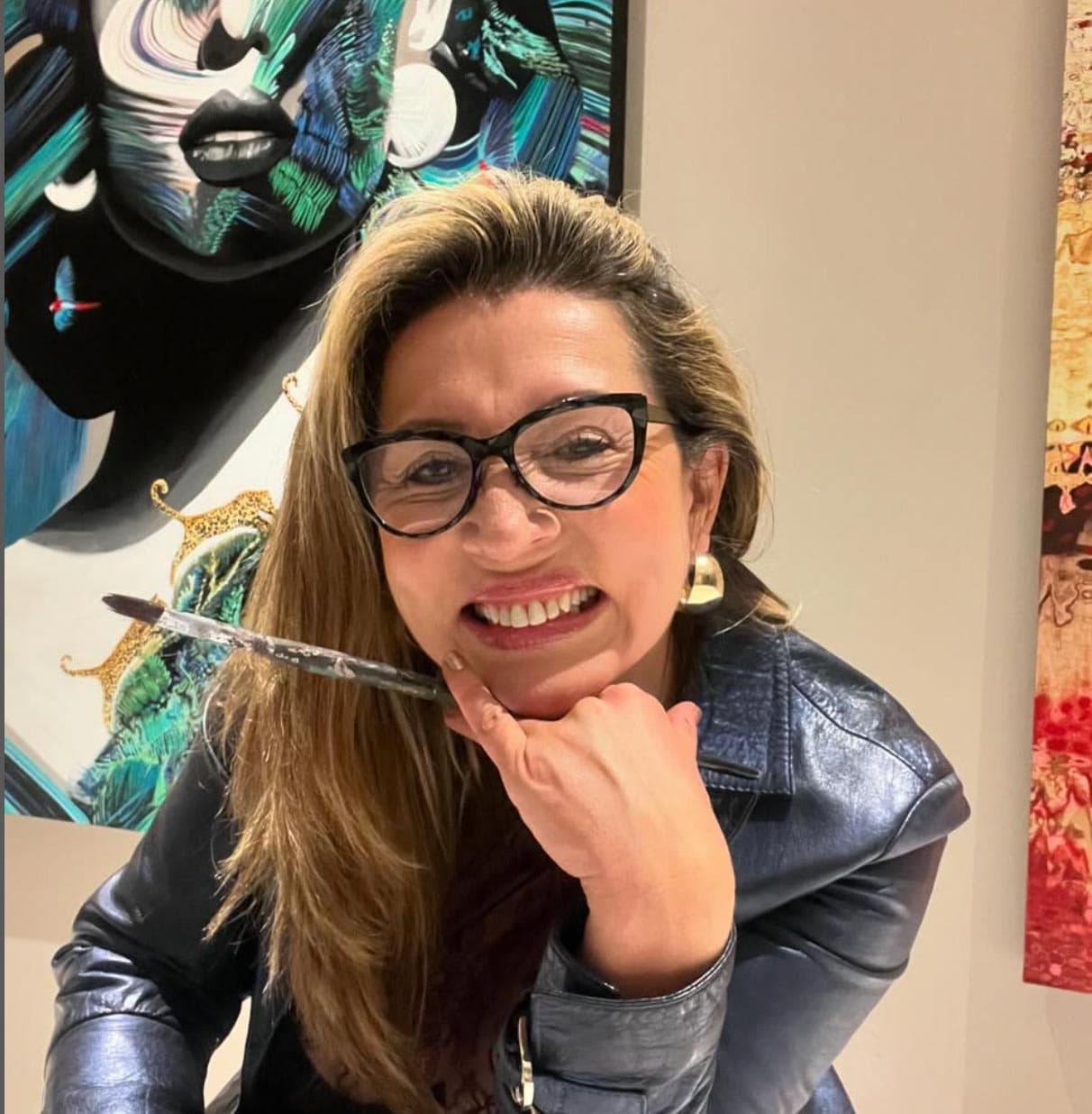
Monica Agudelo was born in Bogotá, Colombia, where her fascination with shapes, color, and visual expression emerged early in life. Guided by an instinctive curiosity for form and meaning, she pursued a degree in Graphic Design at the Jorge Tadeo Lozano University. During her studies, she was selected to join an interdisciplinary research group led by Dr. Rodolfo Llinás, dedicated to creating educational materials about the Amazon as it existed 10,000 years ago. This experience awakened a deep interest in Colombia’s ancestral cultures—an influence that continues to resonate in her work today. Her exhibition “Colombia No Me Olvides” (Colombia, Don’t Forget Me) reflects this connection, serving as a tribute to collective memory and cultural identity. After earning her degree, Agudelo traveled to Europe to further her artistic training and immerse herself in the legacy of the great masters. She was accepted into the École Supérieure des Beaux-Arts in Paris, where her innovative approach and contemporary techniques drew the attention of her professors. Together, they helped bring to life her first solo exhibition in Paris—a study of the human figure rendered in expressive black-and-white compositions, where delicate, minimal strokes revealed profound emotional depth. The exhibition was met with success, with most of her works acquired by collectors. A pioneer in merging traditional fine art with emerging digital processes, Monica Agudelo bridges the past and the future of visual expression. Her practice blends drawing, photography, digital media, and printmaking to explore the evolution of identity and culture. Her visionary approach and technical mastery have positioned her among the first Colombian artists to integrate digital influence into fine art, marking her as a forerunner of modern artistic innovation in her country.
Artist Works
EXPLORING THE WORK BY MONICA AGUDELO
An image between memory and invention
Monica Agudelo's work asks how a picture can carry traces of the past while remaining open to the present. Her paintings and mixed-media compositions do not simply record a person or place. They bring elements into contact: recognizable forms, changes in color, marks that seem to emerge from another layer, and surfaces that remind us an image has been constructed. The biography above introduces her training and her concern with cultural memory. The artworks below invite a slower examination of how those interests become visual. A viewer can begin with the title or subject, then notice the decisions that complicate that first reading.
Memory is rarely as orderly as a conventional portrait. Certain details remain sharp while others shift, overlap, or disappear. Mixed media can give an artist ways to express that instability without illustrating a literal story. A photographic element, a painted passage, or a printed surface may each carry a different kind of evidence. Agudelo's work gains energy where those forms of seeing meet. Rather than forcing a single answer about what an image means, it makes the act of remembering feel active and unfinished. That openness is part of its contemporary character.
The woman as subject, not symbol
Recent reporting in El Espectador describes Agudelo's Mujer-es exhibition and her interest in recognizing women artists and women's experience. That context can deepen a reading of the work, but it should not flatten every figure into the same emblem. A painted woman can be an individual presence, a formal study, a psychological encounter, or a point of connection to broader histories. The viewer should attend to the particular image before assigning it a general message. How does the gaze operate? Is the figure placed within an expansive setting or brought near? What can be known from the painted expression, and what remains private?
These questions matter because even a carefully rendered face cannot tell us everything about its subject. A portrait can invite identification while resisting possession. Agudelo's practice, which includes drawing, photography, digital procedures, and painting, offers several ways to negotiate that tension. One medium may make a person seem immediate; another may create distance or a sense of mediation. The resulting image can give the viewer access to a presence without pretending to resolve a life. Looking with that restraint is a more respectful and rewarding way to encounter her figurative work.
Magia en la Selva and a layered landscape
The current DelPuma Fine Art selection includes Magia en la Selva, listed as a 2023 work made with sublimation and oil on canvas. Its Spanish title, Magic in the Jungle, suggests an environment that is more than a backdrop. A forest can be dense with forms and meanings, yet the title alone does not tell the viewer exactly what is pictured. Start instead with the relationships visible in the artwork: where color gathers, how depth is suggested, and whether a figure, plant, or mark directs the eye. A layered technique can make different parts of the image feel as though they belong to different moments.
Sublimation and oil are identified in the listing, but the label does not reveal every step in the artist's process. It is safer to consider what their combination may permit than to invent a detailed recipe. One part of the surface might carry an image by transfer while another is developed through paint. The interplay can make a scene feel both encountered and remembered. This is especially meaningful for a work whose title evokes the jungle, a place Agudelo has connected in other contexts to questions of Colombia's cultural roots and the need to know what may otherwise be forgotten.
Color as an emotional structure
Blue Night and Rouge, both listed as 2024 mixed-media works on canvas, use titles that foreground color and atmosphere. Blue can suggest evening, distance, or reflection; red can suggest warmth, urgency, or presence. None of those associations should be imposed automatically. The paintings may complicate what their titles appear to promise. Notice how a dominant color behaves beside smaller accents and how light or darkness gives it depth. A title can direct the first glance, while the composition determines how long the viewer stays.
Color also links the more recognizable parts of an image to its less certain passages. It can hold a figure within a field or make the figure appear to move against it. For a viewer comparing these two works, the most revealing question may not be which hue is preferred, but how each composition manages intensity. Does one offer a quiet interval after a strong note? Does the other sustain a continuous visual charge? Agudelo's art is particularly responsive to this kind of comparison because color operates as a means of thinking and feeling, not simply a decorative finish.
I Dream of Freedom and the open image
I Dream of Freedom is listed as a 2024 mixed-media work. Its title is broad and emotionally resonant, but a dream can be personal, collective, hopeful, or unresolved. The artwork deserves more than a single slogan attached to that phrase. Look for how its forms create or restrict movement. Is the viewer's gaze led outward, held within a frame, or returned to a human presence? Does the surface reveal distinct layers that suggest a movement through time? Such formal questions can make the title feel more specific without closing down its possibilities.
Freedom in art does not have to appear as a literal escape. It can be expressed through a refusal of fixed categories: drawing beside painting, an image transformed by digital means, or a composition that resists one stable reading. Agudelo's broader practice makes those possibilities relevant, but each work must be considered on its own terms. For a collector, the title may spark the first connection; the sustaining connection comes from the visual intelligence of the object. The work has to continue to offer something after its message seems familiar.
Digital processes and the hand of the artist
Agudelo has worked across traditional and digital forms, a combination that can be misleadingly described as a contest between old and new. In practice, each method expands the set of decisions available to an artist. A digital image can be altered, repeated, transferred, or placed into a larger composition. Paint can interrupt it, give it texture, or make its edges less certain. The presence of technology does not remove artistic judgment; it shifts where that judgment operates. The viewer can look for the moments when one kind of image-making encounters another.
This is one reason an online reproduction is an incomplete account of mixed-media art. The screen can show composition and color, but it may conceal changes in surface and scale. The listed medium and dimensions are therefore important, as are closer views when available. Ask which passages feel integrated and which retain a productive difference. Agudelo's images can make that difference part of their meaning: an apparently seamless scene may be made from materials with distinct histories. The hand of the artist is present in how those histories are brought into relation.
Colombian roots and contemporary questions
Agudelo's concern with Colombia's ancestral cultures is introduced in the biography, but its importance extends beyond a biographical fact. The contemporary artist can ask what a society remembers, what it overlooks, and how images influence that remembering. An artwork need not recreate a historical artifact to participate in this inquiry. It can make viewers conscious of absence, layering, and the distance between an inherited story and lived experience. Those questions may be especially vivid when a work combines recognizable imagery with interventions that disturb it.
At the same time, it would be reductive to treat every canvas as a coded lesson about national identity. Agudelo works with color, figure, and material presence as well as ideas. Her art can be enjoyed for its visual force before the viewer learns the wider context. That sequence can be productive: attraction leads to attention, and attention opens questions. The best interpretation leaves space for both the immediate encounter and the cultural conversation to which the work may contribute. One enriches the other without turning the painting into an illustration of a résumé.
Looking at Monica Agudelo at DelPuma Fine Art
The four works currently listed here—Blue Night, I Dream of Freedom, Magia en la Selva, and Rouge—offer a focused introduction to Agudelo's contemporary mixed-media practice. Compare the titles, dates, and materials, then return to the images themselves. Which work creates the clearest point of entry, and which keeps changing as you look? Does color lead the encounter, or does a figure or layered detail take hold first? These questions are more useful than assuming that one artwork can stand for the whole of a varied practice.
For a potential collector, the artwork pages provide the dimensions and current listing information needed to imagine each work at its real size. Ask for closer views if the relationship between surface and image matters to your decision. Agudelo's art rewards this kind of care because its meanings are not exhausted by a subject or title. The works occupy the space between what is clearly seen and what must be approached through memory, interpretation, and time. A painting that continues to hold that space can remain alive to a viewer long after the first encounter.
Research: El Espectador interview and exhibition report. Artwork titles, dates, and media are from current DelPuma Fine Art listings.