
Pablo Fernandez Jr
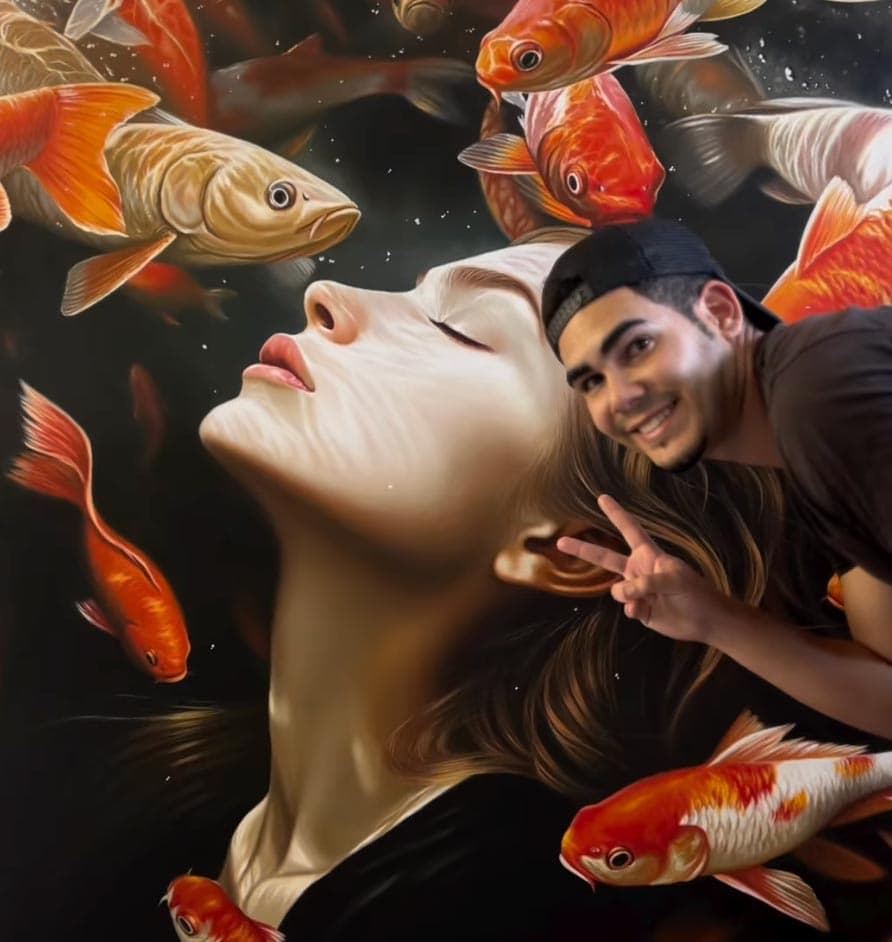
Pablo Fernández Jr. was born in Consolación del Sur, in the province of Pinar del Río, Cuba, in 1999. The son of Cuban visual artists Pablo Fernández and Delma Mejías Montenegro, he grew up surrounded by creativity and craftsmanship. From an early age, he absorbed the contrasting artistic sensibilities of his parents—his father’s meticulous precision and his mother’s expressive spontaneity—forming the foundation of a style that is both technically refined and emotionally resonant. Encouraged by his family and the Cuban cultural community, Fernández Jr. received additional preparation at the San Alejandro Academy, where he honed his technical and conceptual approach. Influences from Cuban masters such as Flavio Garciandía, Roberto Fabelo, and Tomás Sánchez are evident in his compositions, particularly in his treatment of line and form. His work blends figurative realism with elements of surrealism, pop art, and hyperrealism, exploring the expressive potential of the human body and face. Each piece channels psychological depth and visual intensity, inviting viewers to experience emotion through precision. Fernández Jr.’s work has been exhibited internationally and is held in private collections across Mexico, France, Spain, Austria, and the United States. His growing exhibition record reflects both his technical mastery and his global appeal.
Artist Works
EXPLORING THE WORK BY PABLO FERNÁNDEZ JR.
A figure built through patient observation
Pablo Fernández Jr. works with the human figure as a place where technical control and emotional uncertainty can meet. A face may be carefully modeled, yet the person it presents is not exhausted by visible features. The biography above describes his artistic family and his early training. The artworks below invite a more focused look at what he makes from that foundation. Oil paint allows shifts of light, edge, and color that can bring a body forward or hold it at a distance. Such decisions turn a recognizable subject into an encounter rather than a simple display of skill.
His own account of the practice emphasizes portraits and figures capable of transmitting sensation. That ambition is not a promise that every viewer will feel the same thing. A compelling painting can leave its emotion open. One viewer may read stillness as peace; another may find tension in the same gaze or gesture. Fernández Jr.'s contemporary figurative art is strongest when it allows this exchange between artist, subject, and viewer to remain alive. The precision of the image creates a point of contact, while its unanswered questions give the viewer reason to return.
Realism as a beginning, not an end
A realistic image can be impressive at first sight, but accuracy alone does not make a painting memorable. Fernández Jr. can use convincing anatomy and careful modeling to establish trust, then alter the experience through composition, scale, or symbolic surroundings. This is where his interest in figurative realism and more imaginative visual languages becomes productive. The recognizable figure grounds the work; the less expected elements keep it from closing into illustration. A viewer can move between what seems physically possible and what feels psychological or dreamlike.
Looking closely at an oil painting means noticing where detail is concentrated and where it is reduced. A face may receive sharp attention while the rest of a scene softens. A background might be quiet enough to make a gesture seem significant. These choices control the pace of looking. They can also suggest that the visible body carries an inner life that cannot be painted literally. Rather than asking whether a work looks exactly like a photograph, ask how its painterly decisions shape presence, mood, and the sense of a person inhabiting the image.
The titles as invitations to reflect
The current DelPuma Fine Art selection includes Enlightenment, Flower of Silence, Force of Freedom, Renewal, Seeking Balance and Harmony, and Where Silence Lives. These titles point toward states of mind and possible transformations rather than ordinary descriptive labels. They can help a viewer enter the work, but they should not be treated as complete explanations. What does a painted form actually do with the idea of freedom? Does a quiet composition support the word silence, or complicate it? A title can open a question that the artwork keeps active.
Several of the phrases share a reflective tone, yet each painting deserves an individual response. A work titled Renewal might suggest change without depicting a clear before and after. Seeking Balance and Harmony can make a viewer alert to tension as much as resolution. Flower of Silence joins a living form to an absence of sound, a pairing that could be tender, solemn, or more ambiguous. The art lies in the specific relation of image to phrase. Looking first and reading the title again afterward can reveal how much the painting adds to the words.
Oil paint and the texture of feeling
All six works currently listed here are oil paintings on canvas. The shared medium makes comparison useful, but it does not mean they were made in an identical way. Oil can produce smooth transitions, visible brushwork, rich darks, and luminous layers. An individual painting may favor some of those possibilities over others. The listing tells us what the principal medium is; the surface itself tells us how it was handled. A close look or detailed image can reveal whether a passage feels polished, interrupted, or intentionally left open.
These material choices affect emotion. A softened edge can make a figure seem to recede into thought; a strong highlight can make a face feel immediate; a visible stroke can remind the viewer that the image is a human construction. None of those effects carries a fixed meaning in every work. Their value lies in how they operate together in a particular composition. For Fernández Jr., oil painting is not simply a traditional vehicle for realism. It is a flexible language for bringing outward appearance into contact with inward experience.
Where Silence Lives and the space around a figure
Where Silence Lives is listed as a 2025 oil painting available to commission. The title raises a question that cannot be settled by the words alone: is silence found in a person, a landscape, an interval between forms, or the viewer's own response? The available listing does not provide a detailed description, so the image should guide interpretation. Look at the amount of space around the central subject. Does that space feel protective, isolating, or simply calm? How do light and direction of gaze affect the answer?
The commission note is also relevant for anyone considering the work. It signals that the listing may represent a direction rather than an immediately available original object; details should be clarified through an inquiry. A commission can involve decisions about size and presentation, but it should not be assumed to reproduce an existing painting exactly. The important first step is to understand what attracts you to the image: its subject, mood, use of light, or a more elusive sense of pause. That conversation can lead to a clearer request and a better understanding of the artist's approach.
Freedom, renewal, and the risk of easy answers
Titles such as Force of Freedom and Renewal carry a positive charge. It would be easy to read them as declarations and move on. Figurative painting can do something more subtle. A figure may appear strong and vulnerable at the same time; a change may feel uncertain rather than complete. The best way to approach these works is to let their visual details complicate the encouraging words. Where does the composition suggest movement, and where does it resist it? What is emphasized by color or light, and what remains difficult to see?
This approach honors the emotional reach of the titles without turning the paintings into motivational posters. Fernández Jr. has described enjoying the process by which a work seems to take on a life of its own. That observation suggests openness during making, not merely the execution of a predetermined message. A viewer can mirror that openness. Rather than demanding one final interpretation, allow the image to hold several possibilities at once. A painting can be hopeful and unsettled, serene and forceful, depending on where one looks and how long one stays.
A Cuban artistic inheritance in a contemporary voice
The artist grew up among makers and has named the importance of support from family and cultural institutions. That inheritance helps explain the confidence with which he approaches drawing and the figure, but it does not mean his paintings are simply an extension of earlier Cuban art. A younger artist receives techniques, images, and expectations and has to decide what to keep, question, or redirect. Fernández Jr.'s interest in portraiture and more imaginative composition can be seen as part of that process of forming an individual voice.
It is useful to distinguish context from a formula. A birthplace or family history can illuminate the work, but it cannot tell a viewer exactly what to see in every canvas. The paintings must be allowed their own formal and emotional particularity. Notice how one figure is placed differently from another, or how a familiar art-historical concern with likeness is made contemporary through cropping and atmosphere. The artist's background enriches that looking; it should not replace it. In this way, his work can speak across cultural contexts while remaining grounded in a specific artistic formation.
Looking at Pablo Fernández Jr. at DelPuma Fine Art
The six current listings, dated 2024 and 2025, provide a concentrated view of Fernández Jr.'s oil painting. Compare them for how each balances recognizable form with a title that points beyond appearance. Which work gives you the strongest sense of an individual presence? Which creates its effect through surrounding space or a more complex visual arrangement? Consider the listed dimensions as well as the screen image. A painting's scale can change whether a face feels intimate, public, or almost monumental.
For a collector, the process begins with an image that holds attention and continues with questions about the physical object: surface, size, availability, and how it might live in a room. The current artwork pages provide a starting point, while an inquiry can clarify details, especially for a work marked available to commission. Fernández Jr.'s paintings offer a reason to slow down. Their technical refinement draws the eye, but their enduring interest lies in the space they leave between a clearly rendered human form and the feelings a viewer brings to it.
Research: Pablo Fernández Jr.'s official artist biography. Artwork titles, dates, media, and commission status are from current DelPuma Fine Art listings.