Tommaso Fattovich
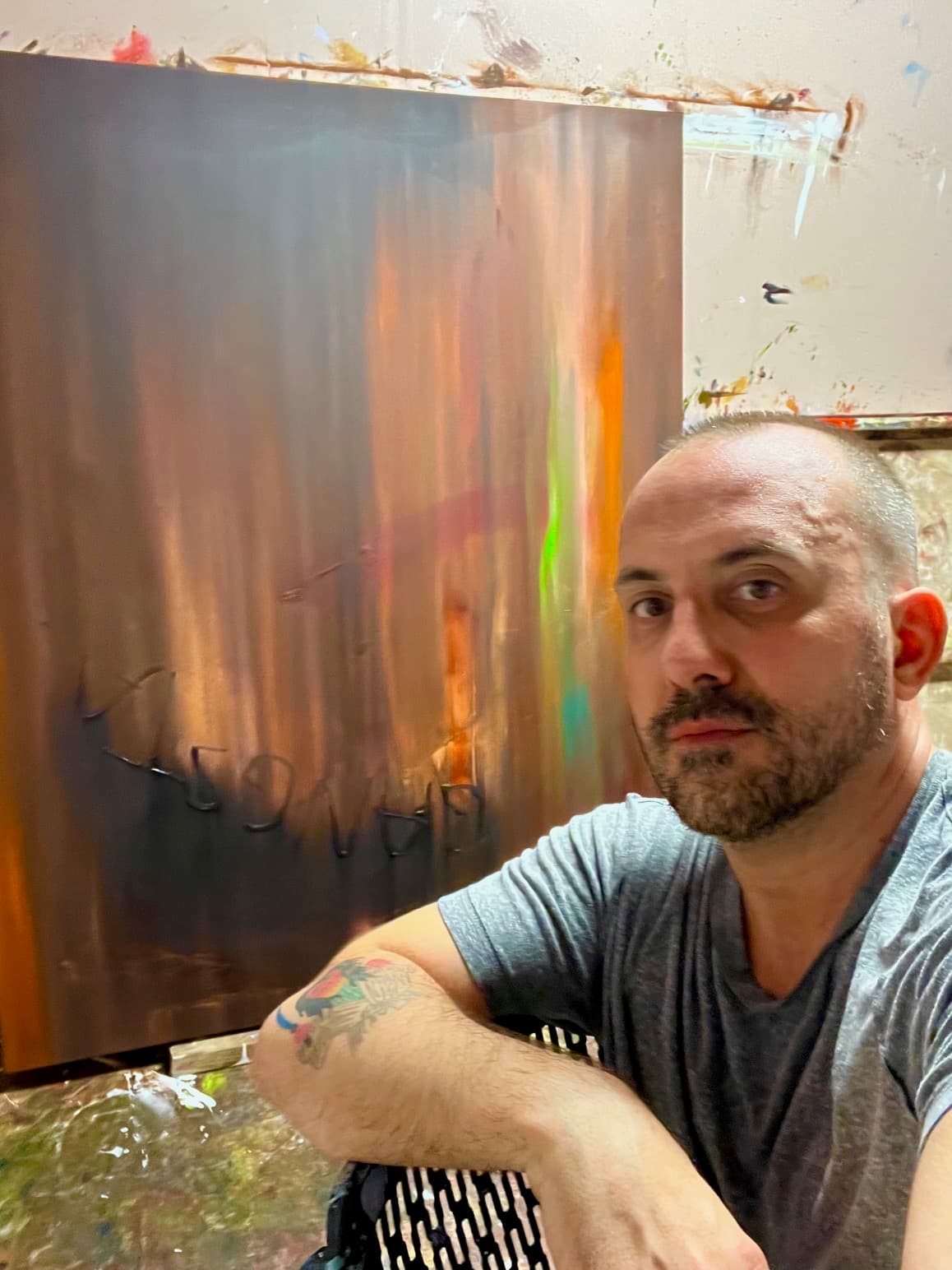
Tommaso Fattovich was born in Milan, Italy, where his earliest exposure to art and culture laid the foundation for his creative journey. In his teens, his family relocated to the United States—an experience that would later infuse his work with a unique tension between European refinement and American rawness. Drawing from both worlds, Fattovich channels their contrasts into a visual language that is bold, unrestrained, and deeply personal. A self-taught painter, Fattovich values artistic independence above all. In the solitude of his studio, he distances himself from outside influence, creating from a place of instinct and authenticity. His paintings—visceral, gestural, and charged with energy—invite viewers to confront the unseen rhythms that pulse beneath the surface of everyday life. Fattovich describes his style as “Abstract Punk”—a rebellious fusion of abstraction and raw expressionism. Rejecting convention, he employs oils, acrylics, and unconventional tools such as plaster trowels and forks to sculpt dense textures and dynamic layers onto large-scale canvases. “I use whatever I can to make that mark,” he says. “It’s not even a brush stroke.” His creative process unfolds intuitively, guided by emotion and impulse, until each work reveals its final form—a moment he calls the most rewarding in his practice: when the painting “becomes what it was meant to be.” His first exhibition emerged amid the rise of Miami’s Wynwood Art District in 2010, a period that helped define his presence in the contemporary art scene. Since then, Fattovich’s work has been exhibited in Miami, San Francisco, Palm Springs, Los Angeles, Las Vegas, Boca Raton, East Hampton, New York City, and the Netherlands. He currently lives and works in Boca Raton, Florida.
Artist Works
EXPLORING THE WORK BY TOMMASO FATTOVICH
A painting that keeps its sense of motion
Tommaso Fattovich's paintings invite the viewer to follow a mark rather than search immediately for a recognizable scene. A streak may seem to cross the canvas in a single burst, while a denser area reveals slower additions and revisions. This contrast makes his abstract work feel active even after the paint has dried. The surface holds evidence of decisions made at different speeds. It is possible to enjoy the energy at first glance and then find a more complicated structure underneath it: one form interrupting another, a bright color pushing forward, or a dark passage pulling the eye into apparent depth.
The term Abstract Punk, which Fattovich uses for his practice, points toward independence and experimentation. It should not be mistaken for a lack of judgment. An open process still requires choices about where a composition begins, how long it develops, and when to stop. What looks spontaneous can depend on careful responses to what is already on the canvas. Fattovich's paintings gain their force from this balance. They welcome accident without surrendering to it. A viewer can move between the immediate sensation of a gesture and the more deliberate relationships among color, scale, texture, and open space.
Reading a layered surface
Oil and acrylic do not behave in exactly the same way, and combining them can create a surface with several visual registers. Some marks seem to sit on top, while others appear partially buried under later paint. Scrapes, broad passages, and abrupt changes of color make the sequence of making perceptible without revealing every step. Fattovich has worked with hands and unconventional tools as well as painting implements. The important result is not the novelty of a tool, but the kind of mark it permits. A dragged edge, for example, can create a different rhythm from a rounded brushstroke.
Looking closely, it is useful to ask where the surface resists easy reading. Does a shape suggest a building, a fragment of sky, or only a collision of colors? Fattovich's imagery has been associated with damaged or weathered environments, but the paintings do not require a literal map. Their layered textures can evoke erosion, accumulation, and the marks left by time. A viewer may recognize an urban feeling without identifying an actual street. That openness is part of the work's appeal: the canvas supplies visual evidence, while the viewer brings memory and association to the encounter.
The city as a visual memory
Fattovich's connection to Milan and Florida is already part of the biography above. The paintings allow a different question: how might a place be remembered without being depicted? A city leaves traces in a person's visual habits. Faded walls, patched surfaces, signs, traffic, and sudden flashes of color can remain in memory as fragments rather than complete pictures. An abstract composition can bring those fragments into contact without promising a faithful view of any one location. This is a way of discussing urban influence without reducing every line to an architectural feature or every patch of paint to a particular street.
The coastal environment offers another register. Light can flatten some colors and make others more intense. Weather changes the appearance of built surfaces, while open horizons alter a sense of scale. Fattovich's work need not be assigned one source or the other. Its energy may come from the friction between different ways of seeing. A warm field and a dark mark, a hard edge and a diffuse passage, can coexist without resolving into one story. This gives the paintings an emotional charge that is recognizable even when the subject remains uncertain.
From individual gesture to overall composition
A single gestural mark can be compelling, but an entire painting must give that mark somewhere to live. Fattovich's compositions are most revealing when the viewer alternates between a distant and a close view. At a distance, broad masses of color establish movement across the canvas. Up close, the surface shows smaller interruptions and changes of texture. Neither view is complete by itself. The work asks the eye to assemble the whole and then test that impression against details. This back-and-forth makes a large abstract painting feel less like a fixed image and more like an unfolding encounter.
Open space can be as important as densely worked paint. An interval allows a strong passage to register, while two adjacent areas of activity may create pressure or speed. The apparent disorder of a surface can therefore be carefully balanced. One need not reconstruct the artist's exact sequence of decisions to recognize this. It is enough to notice where the painting gives the eye a pause and where it sends it onward. The ability to sustain that movement over time is one reason an expressive canvas can remain engaging after its first impact has become familiar.
The works presented by DelPuma Fine Art
The paintings currently listed at DelPuma Fine Art include 8 1/2 Bit, Wild Strawberry, Chido, Parallel Universe, Casa Dolce Casa, Space Octopus, Lemonade, Passed Me By, and Stalemate. Their titles range from playful and colloquial to suggestive and enigmatic. They invite an initial response, but they do not lock the viewer into a single interpretation. A title such as Parallel Universe may encourage a search for distinct visual worlds within one canvas; Lemonade may set up a different expectation of color or mood. The image itself should have the final say. It can confirm, complicate, or entirely redirect the association prompted by the name.
These works are identified as oil and acrylic on canvas in the current listings. Several are substantial in scale, a detail that matters when judging their physical presence. A large gestural painting can engage the viewer's peripheral vision and change the energy of a room. A smaller one may invite a more intimate reading of its marks. Dimensions are therefore more than a shipping detail. They help explain how the painting might be experienced in person. Anyone comparing Fattovich works online should consider the scale alongside the color and composition, then examine the individual artwork page for current details.
Home as a subject without a literal house
A 2026 museum presentation titled Casa Dolce Casa connected Fattovich's abstraction to the idea of home as both a place and a state of mind. That framework is useful because it does not ask a painting to illustrate a room. Home can be suggested through warmth, friction, memory, or the marks left by living somewhere. An abstract surface can carry these associations without showing a doorway or a familiar address. The viewer may find comfort in one color relationship and restlessness in another. Both responses are possible within the same work.
This also offers a way to think about the artist's expressive marks. A painting can be a record of returning to a surface, covering some passages and preserving others. That layered process resembles the way places accumulate meaning through repeated experience. It would be too simple to call each gesture autobiographical, but the work makes room for personal histories. The viewer does not have to know the artist's private memories to bring their own. Fattovich's open compositions can become a meeting point between the material facts of paint and the less visible associations a person carries into the gallery.
Choosing and living with an abstract canvas
When considering a Tommaso Fattovich painting, start with what continues to draw your attention after the first glance. Is it a color that changes against the surrounding wall, a particular interruption in the composition, or a sense of movement that becomes clearer from across the room? View the image at more than one size if possible. A small screen can compress texture and flatten the difference between an opaque layer and a scraped one. In person, those differences help establish the work's character. They can also change under daylight and evening illumination.
Placement can support the painting's energy without competing with it. Give a heavily worked canvas room to breathe, and consider how its strongest direction of movement relates to nearby furniture and architectural lines. There is no universal rule that a colorful painting needs a neutral room. What matters is whether the surrounding space allows the painting's internal relationships to remain legible. A work that initially seems loud may reveal quiet passages on repeated viewing. Conversely, a restrained area may gain force beside a vivid one. Living with the painting makes these shifts part of the pleasure of ownership.
Why Fattovich rewards a second look
The most interesting abstract paintings do more than deliver an immediate mood. They keep presenting new relationships among their parts. Fattovich's work offers that possibility through layered materials, irregular marks, and titles that invite but do not dictate interpretation. One viewer might follow the physical history of a painted surface; another might respond first to its emotional temperature. Neither reading excludes the other. The work is strongest when sensation and attention can coexist: a painting can feel direct and still be complex enough to withstand close inspection.
DelPuma Fine Art's current selection is an opportunity to compare those qualities across several paintings by the same artist. Look at how an area of color behaves from canvas to canvas, how a rough passage differs from a smooth one, and how each title changes an initial expectation. This comparative approach can help a collector discover a preference that is more specific than liking abstraction in general. It also respects what Fattovich's process makes visible: each finished canvas is its own set of decisions, not simply another example of a style.
Research: artist profile and technique and reporting on the 2026 museum presentation. Artwork titles, media, and dimensions are from current DelPuma Fine Art listings.