
Véronique Barrillot
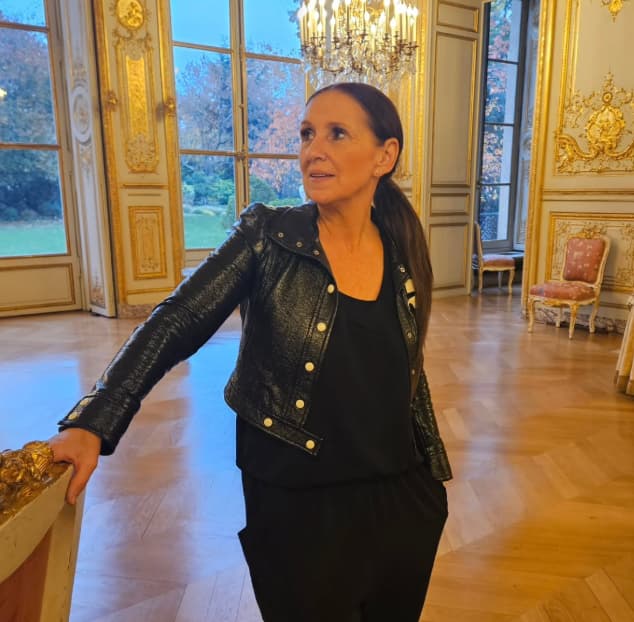
Véronique Barrillot is a French contemporary artist renowned for her groundbreaking Double Vision paintings, works that reveal two distinct images within a single canvas. Depending on the viewer’s position, distance, and movement, an entirely different image emerges, transforming the act of viewing into an active and deeply engaging experience. Her work challenges conventional perception, inviting audiences to slow down, look again, and discover multiple realities within the same piece. Drawing from years of experience as a large-scale mural painter, Barrillot developed an extraordinary ability to control visual distance and perspective. This led to the creation of what has become known as Quantum Painting—a term inspired by the superposition of two visual states existing simultaneously within one artwork. Rather than relying on optical illusions, digital effects, or artificial intelligence, each painting is meticulously created by hand, requiring both technical mastery and a remarkable understanding of how the human eye processes information. Born in Lyon, France, in 1969, Barrillot is a self-taught artist whose innovative work has attracted international attention from both the art world and the scientific community. Researchers at the Clinical Neurosciences Department of CHUV Lausanne have studied her unique visual processing abilities, while collectors have embraced her work for its originality and intellectual depth. Her paintings have been exhibited throughout Europe and the United States, including Paris, New York, Miami, Palm Beach, Lausanne, and Monaco. In 2017, she received the prestigious Jean-Charles Hachet Prize, and her work is represented in prominent collections and institutions, including the POPA Museum of Modern Art in Switzerland.
Artist Works
EXPLORING THE WORK BY VÉRONIQUE BARRILLOT
Two images, one sustained encounter
Véronique Barrillot's paintings ask for more than a quick glance because the first image a viewer recognizes is not necessarily the only one present. A second subject becomes legible as distance changes. The experience makes looking an active part of the artwork: approach the canvas, step back, and test how the overall arrangement shifts. The change is not a video transition or a hidden digital layer. Both subjects have been painted into the same physical surface. What changes is the viewer's ability to organize marks into an image. This makes the work especially difficult to understand from a single photograph, which holds one distance and one moment still.
The Double Vision method is compelling because it makes perception visible to us. We usually recognize a face, object, or symbol so quickly that the work of recognition goes unnoticed. Barrillot interrupts that habit. A cluster of marks that serves one image nearby can contribute to another from across the room. Rather than offer a puzzle with a single answer, the painting encourages a continuing exchange between two readings. Once both are known, the viewer can move back and forth between them and notice the formal decisions that allow each to appear. That sustained attention gives the work a life beyond the initial surprise.
Distance as part of the composition
Most paintings change somewhat when seen from different distances. Barrillot makes that ordinary fact central to her practice. Fine detail may dominate at close range, while broader relationships among shape, value, and color become clearer farther away. Her experience with large murals helps explain the importance of scale: an image intended for a distant passerby must be constructed differently from one studied at arm's length. In a Double Vision canvas, those two viewing conditions become equally important. Neither is merely a preparatory step toward the other. Each offers a distinct encounter with the work.
This creates an unusually physical form of spectatorship. A viewer cannot understand the piece fully by remaining in one spot. Small changes in position may be enough to unsettle an image, while a larger step back can make a second subject cohere. The room is therefore part of the viewing experience. Wall space, sightlines, and lighting affect how easily someone can test the painting's two scales. The painting remains still, but the path through which it is understood belongs to the moving body. That is a useful distinction: its dynamism comes from the relationship between object and observer, not from a mechanical effect.
Why a photograph can show only part of the work
Barrillot's own website acknowledges a practical difficulty: a photograph cannot reproduce the changing experience of standing before one of her Double Vision works. A camera records one framing and one focal relationship. The artist presents paired views online to help people compare what may appear near and far, but even that device is an introduction rather than a substitute for moving in front of the original. This is relevant for collectors exploring the work digitally. A product image can document color and composition while still concealing the moment when another subject takes shape.
The limitation can also teach us how to look. Instead of treating the photograph as the painting's final meaning, try to notice the scale of marks and the way small passages contribute to a larger structure. Imagine how the canvas might fill more or less of the visual field as you change distance. If possible, compare more than one view of the same work. The point is not to decode every detail before seeing the original. It is to recognize that the painting has been designed for a sequence of encounters, each of which may change the first impression.
Cultural images in conversation
The subjects Barrillot selects often come from recognizable histories of art, literature, public life, and popular culture. Pairing two such references allows a painting to create a conversation without illustrating a conventional narrative. The relationship may be formal, historical, ironic, or deliberately unresolved. A viewer might recognize one figure before another and then reconsider the first in light of the second. In this way, the Double Vision structure becomes more than a demonstration of skill. It gives the artist a means to ask how images acquire meaning when placed in a new relationship.
Her official work archive includes combinations such as a typewriter with Albert Camus, an airplane with Antoine de Saint-Exupéry, and a distant view of New York imagery that resolves differently at close range. These pairings invite curiosity, but recognition is not a prerequisite for appreciating the painting. A person unfamiliar with one reference can still experience the shift in scale and form. Learning the cultural associations may deepen a later visit. The work allows both responses: the immediate visual discovery and a slower consideration of why these two subjects were brought together on one surface.
Works presented by DelPuma Fine Art
The current DelPuma Fine Art listings include New York Sous Les Bombes (Spray Paint vs. JM Basquiat), Camp'Hell 16 (Campbell Soup vs. A. Warhol), and Kanun (Eagle vs. Mother Teresa). The paired names in these titles make the artist's method unusually explicit. They tell us that the paintings are built around two subjects, but they do not tell us exactly how each will emerge in person. That remains the viewer's discovery. All three listings identify acrylic on canvas, giving the works a shared material basis even as their themes and dimensions differ.
New York Sous Les Bombes invites a conversation between the material trace of spray paint and the image of an artist associated with a city. Camp'Hell 16 uses the language of a familiar consumer object and a major figure in twentieth-century art. Kanun places an eagle alongside Mother Teresa. These descriptions should be treated as guides to the paired subjects, not as complete interpretations. The interesting question is how Barrillot makes each pair coexist visually. Comparing the three works may reveal different approaches to scale, density, and the point at which one image gives way to another.
A metaphor from physics, not a laboratory claim
Barrillot has used the language of superposition and Quantum Painting to describe the coexistence of two painted states. It is an evocative metaphor for an unusual visual experience. It should not be mistaken for a claim that the canvas demonstrates a quantum-physics experiment. The painting operates in the familiar world of pigment, distance, and human perception. Its conceptual force comes from making two possibilities available within one composition while allowing the viewer to encounter them at different moments. The metaphor can open a philosophical discussion, but the art itself is best approached through careful looking.
That distinction helps keep the experience accessible. No scientific expertise is needed to appreciate the work, and no technical explanation can replace the act of standing before it. A person can notice a subject coming into focus, move closer, lose it, and find another arrangement in the same marks. The process may prompt questions about certainty, attention, and the limits of a single viewpoint. Those questions belong to the viewer as much as to the artist. Barrillot's achievement is to give them a concrete, repeatable form in paint.
The role of scale, light, and placement
A Double Vision painting needs enough space for a viewer to change distance. A cramped passage may make one image easy to see but limit the movement required to discover the other. When considering placement, look for a clear approach from nearby and a sightline from farther across the room. This does not mean that every work needs a vast wall; it means that its two viewing scales should be considered before installation. The exact distance will depend on the painting's dimensions and the particulars of its composition.
Lighting also deserves attention. Glare can interrupt fine detail, while weak illumination can flatten the differences that allow subjects to emerge. Even, comfortable light gives the eye a better chance to compare both views. A collector might take several steps back, return to the surface, and then repeat the movement under another lighting condition. The experience should feel exploratory rather than like a test with a correct answer. Over time, knowing both images can change how a person lives with the painting: one reading may greet them on entering a room, while another reveals itself when they stop nearby.
Returning to Véronique Barrillot
The strongest reason to return to Barrillot's work is that discovery does not end once the paired subjects have been identified. A viewer can ask how a particular passage operates within each image and why one reading becomes stronger at a given distance. Colors and marks that first seemed secondary may prove essential to both. This formal curiosity makes the painting more than an optical novelty. It becomes a sustained investigation of how a picture is built and how an observer participates in bringing it into focus.
DelPuma Fine Art's artist and artwork pages offer a starting point for comparing the current paintings, their paired titles, dimensions, and materials. For someone considering a work, the next step is to ask how it might be viewed in the intended space and whether both distances are available. For someone simply exploring contemporary French painting, the work offers a memorable invitation: do not assume the first image is the whole story. Step closer, step away, and allow the canvas to change without changing at all.
Research: the artist's explanation of Double Vision and official artwork archive. Current artwork titles, media, and dimensions are from DelPuma Fine Art listings.